NASA and the Environment: Science in a Political context

If you ever wondered why NASA should have employed Hansen, who was such an eco-activist that I understand he was arrested six times, this incredibly revealing document, from NASA’s “Societal Impact of Spaceflight” (2007) explains why. In part NASA used the environment to justify massive funding for itself, in part as NASA itself says:

NASA realized that it needed to research environmental-atmospheric impacts of the shuttle to defend itself, if necessary, against possible opposition more positively, Fletcher sought to align his agency with environmental values. In 1973, he told congress that NASA should be considered “an environmental agency.” he declared: “everything we do …helps in some practical way to improve the environment of our planet and helps us understand the forces that affect it. Perhaps that is our essential task, to study and understand the earth and its environment.”

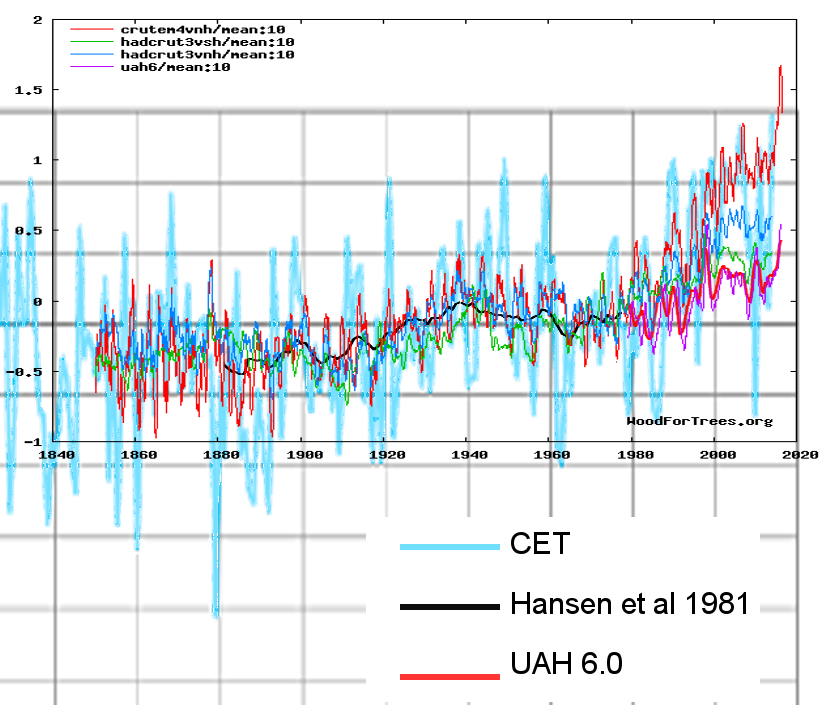
nasasurfacetemp1981-1999-2014That’s right! It was no accident that NASA brought in eco-activists. Indeed, it appears to have been part of a deliberate policy to align itself with the environmental movement and to use environmentalism to create alarm thereby justifying its own budgets to the politicians and public.

That is why NASA climte could fabricate the data apparently with impunity – the policy of egging the data to fit an environmentalist agenda was sanctioned at the highest level within NASA


NASA and the Environment: Science in a Political context

W. Henry Lambright

The advent of the space age has paralleled the rise of the environmental movement. NASA was born in 1958 and Rachael Carson wrote silent spring in 1962; that book is generally seen as marking the onset of modern environmentalism. NASA has intersected with the environmental movement—a set of values and interest groups concerned about the need to protect our natural setting for the current and future generations—in many ways over the years. How did NASA do so? How did it evolve an environmental mission? What did it do with that mission? What were the consequences for society—and NASA—of its environmental role? To answer these questions, this paper will discuss two of the most important ways NASA and the environmental movement related.

First, NASA has had direct impacts through the images of earth taken by Apollo astronauts as well as by satellites in earth orbit. Those satellite images and theories about earth as a system evolved into an organized NASA program, initially called mission to planet earth (MTPE), later the earth sciences program. Second, there was an indirect relation through NASA’s mission from earth. comparative planetology came into existence as a new field; learning about other planets stimulated better understanding of earth.

There are many other issues in the NASA–environment relation, such as space debris and the contamination of other planets, but these two themes—earth monitoring and comparative planetology—are especially salient in NASA’s history, present, and likely future. The first theme focused on the use of space-based remote sensing and became the dominant emphasis in NASA’s environmental history.

There evolved a set of satellites that can be seen as environmental satellites. They are the centerpiece of NASA’s mission to earth. That mission has had an uncertain, somewhat uneasy relationship with other parts of NASA and other agencies. Some people think it is NASA’s most societally relevant mission whereas others think it is extraneous to NASA and belongs somewhere else—the national oceanic and atmospheric administration (NOAA) is the usual candidate. Virtually every observer has found it a controversial mission, one in need of high-level policy attention and improvement for the sake of NASA, the nation, and the world.

The second theme, comparative planetology, has indirectly influenced the main debate—a reminder of the fact that earth is an island home in the vast sea of space and is the only planet (so far) supporting life. NASA’s long association with the environmental and earth sciences has been fruitful but it has also been contested and even tortuous. The history of NASA and its environmental mission is one of science in a political context.

Beginnings in the Apollo Years

Continue reading

Posted in Climate | Comments Off on NASA and the Environment: Science in a Political context

Volcanic apocalypse happening right now?

Today I read on Tallblokes blog:

“Why are “giant fountains of lava” suddenly pouring out of some of the most dangerous volcanoes on the entire planet, and why are so many long dormant volcanoes suddenly roaring back to life? ” sott.net/article/344087…

I don’t know the truth of this claim, however if you add it to my own article:

Massive Volcanic eruptions with clouds of sulphur gas caused runaway heating that ended ice-age claims Independent Scientist.  (PR Link, Science link)

And if you then add some NASA “magic”:
nasasurfacetemp1981-1999-2014A scurriless tabloid journalist could make quite an interesting story along the lines of global warming causing volcanoes. Fortunately, I’ve found a secret technique to stop the press printing these kinds of stories**.
**(you know the way the press won’t touch a story from a sceptic with a barge pole!!)

Posted in Climate | 1 Comment

The joys of shredding paper

The great thing I’ve discovered with shredding old files is that because they get bulked up in the shredder, it looks like you’ve done a lot more work than you have.
The highlight was shredding the whole Scottish executive (a huge organisational chart poster) which went through with a satisfying squeel.
With seven bin bags full, I’m really starting to appreciate the benefits such as leg room to push my chair back, a lathe that no longer acts as a filing cabinet draw, and £35 which had somehow dropped to the bottom of the real filing cabinet (although it looks so old I’m not sure it’s all still legal tender).

Posted in Climate | 4 Comments

A diplomatic silence

Over the years I have enjoyed the freedom to comment & speculate on what I thought was going on in the area of climate.
However, recently I’ve written a string of articles, but have at the last minute decided that such articles would be of no use to the Republicans in the US, but instead could assist the Greenblob.
So, if you notice an ominous silence from me, … it’s because I’m trying desperately to keep a diplomatic silence.

Posted in Climate | 2 Comments

Global Warming Alarmism forecast: Cooling 2036 +/-10yrs

For a while I’ve been convinced there is a strong correlation between the Atlantic Multidecadal Oscillation and “global temperature”. AMO is shown below, I was going to post a graph of global temperature, but the problem these days is finding any graph that any longer represents global temperature (most are just the fraudulent lies of data adjusters  – let’s hope that soon changes!!).


However, this post is not about the fraudulent global temperature, instead I was trying to work out when the peak AMO was /will be and also the peak cooling. We have on this graph the following very rough dates:

  • 1860-1880 maximum
  • 1890-1905 – cooling
  • 1910-1920 – minimum
  • 1930 – warming
  • 1940-1960 -maximum
  • 1967 – peak cooling
  • 1973 minimum
  • 1990-2000 warming
  • 2000-??? – maximum

This gives rise to the following:

  • max-max ~80yrs
  • cool-cool ~70yrs
  • min-min ~60yrs
  • warm-warm ~ 65yr

We also have the start of another maximum at 2000, but as yet no end.  There are other similar starts at 1860 & 1940. This gives another estimate of 70 years. Including this with the above we obtain an average of:   69yrs with a typical range of +/- 10yrs.
Maximum
If this patterns continues,  give the best estimate of the last maximum was 1950 – (80-70)/2 =  1945, the best estimate of the next maximum is 1945+70 = 2015 (range 2005-2025).  This is a little later than would be expected with an earliest start of the maximum at 2000.
Cooling
Best estimate of maximum cooling is 1967 + 69yrs =  2036 (range 2026-2046)
Worst/best Scenario global temperature
The best estimate is that the AMO maximum will end at latest around 2025.

Whilst we’ve not yet plunged into a deep La Nina and may even appear to be coming out of the recent small La Nina into El Nino, the simple fact remains that most large or long El Ninos are followed by a substantial La Nina period. It’s also true that strong La Ninas tend to happen in Autumn/winter. But perhaps because of the timing of the 2016 El Nino, the winter La Nina did not have time to develop and it was smaller than expected. If however La Nina like or neutral conditions hang around in 2017, it may herald a larger La Nina peak developing as we approach Xmas.
However …mother nature does not like doing anything predictable.
If we do have a La Nina, we are likely to see cooling for perhaps 1-4years. So, any La Nina cooling will end in plenty of time for another El Nino to kick us into a warm spike perhaps around 2021-2025. So if AMO is dictating global temperature, then any El Nino after the La Nina is likely to kick up temperatures again.
However … if we don’t get a La Nina and instead we go into El Nino. That means we may see warmer temperatures for perhaps 2-4years. If so, and AMO is dictating climate, then the next El Nino will be too late to show as “exceptional” warming.
Global Warming Alarmism Forecast
As a very rough estimate, it therefore appears that we have another 3-8 years of “global warming alarmism” to deal with. We must not forget however, that we expect very modest warming from the rise in CO2. This may slightly delay any warming and could modestly enhance any El Nino warming peak. So, it is possible that there will be another El Nino warming stronger than the last two in the next 8 years. However, (without data fiddling) this will not be anywhere near large enough to match the global warming forecasts, but it will be large enough to keep the hopes of alarmists alive.
However around 2025 it is likely we will begin to see a substantial drop in global temperatures with a peak cooling expected 2026-2046. If this cooling occurs, then we will undoubtedly see a resurgence of the global cooling alarmism, if this cooling does not occur, then either the effects of CO2 are greater than that of their direct greenhouse effect, or AMO is not a good predictor of global temperature. And global warming alarmism will flourish.
However
If the alarmists are not totally removed from their jobs by Trump and other governments – then it will become so endemic that we’ll have no idea what is happening to global temperature – and we may as well go back to sacrificing goats.
Posted in Climate | 2 Comments

The Caledonian Party

There is currently a “gap” in politics in Scotland which is for a party with Scotland’s best interests at heart which is not obsessive about independence nor anti business as all on the left now are.
I’ve been looking for a suitable party for years, and unfortunately, the choice either appears to be a mainstream party run from England or a party whose policies seem to have been written by some academic “political scientist”.
So, today I thought I’d try to produce a simple pragmatic party manifesto:

  1. The party will be known as the Caledonian** Party
  2. We are committed to a democracy that works both in the sense of the most pragmatic means to allow the people’s voice to decide our future, but also in the economic sense of a balance between the rights of individuals and the need to earn our way in the world.
  3. We are a Scottish party, not by nationalist inclination, but as a party working for the best interests of the people of Scotland whether they decide to be part of a wider Union or not.
  4. We are for public provision and support for good quality education so as to provide the next generation the necessary skills to enhance and grow our economic, social and political skills for the interests of all of us. We aim to modernise further education and will invest to enable Scotland to become a world leader in the provision of internet based supply of further education. In addition we aim to open up research & other funding to target older retired or otherwise economically inactive individuals, with the aim of better utilising this vast untapped reserve of talent.
  5. We believe we all have a responsibility to do what we can to keep ourselves fit & healthy, but we also believe medical care for the sick is a hallmark of a civilised society. Thus we  support the public delivery of high quality medical treatment which should remain free to those with serious medical needs.
  6. We support private enterprise. As such we will aim for a long-term change to rebalance the Scottish economy, working to increase the size and profitability of the tax-giving private sector and reducing the burden of unnecessary red tape.
  7. We aim to have evidence based public policy and in order to support this, we will invest in the necessary research within Scotland to cover all relevant policy areas such as  economic development, environment, climate, education, social & health policy.
  8. We are committed to human rights not as a luxury given to a few who have the means to enforce their rights in law, but as a general principle that all of us should be free from excessive or unnecessary government control of our lives.
  9. We support our armed services and will support the provision of the necessary arms and personnel for a modern functional army.
  10. We will work to improve the transport, energy and communication infrastructure of Scotland with the aim of providing equitable and affordable use across Scotland wherever practical.

Finally … it is time Scotland had an ambition.The US has chosen to go to Mars. Whilst Scotland is much smaller, that does not mean we shouldn’t have ambition. So we too should set ourselves a goal. Whilst that need not be a mission in space, there are nonetheless other important goals, that are achievable and within our means and which would unite our scientists and society. Such a goal, would define us not just for a few years or even a generation, but for many generations to come ideally making us a world leader.
**The name is not important.

Posted in Climate | Comments Off on The Caledonian Party

#M80: Scottish Government get apology in early: SORRY! SOMETHING WENT WRONG

I spotted that there were problems on the M80 on twitter – a road that goes from us to Glasgow, so I immediately started looking into it. Eventually, as things quietened down I remembered the Scottish government have this site called “Traffic Scotland”. It is undoubtedly one of the worst sites I’ve ever used. I have literally spent half an hour as a passenger on the road trying to find my way through their appalling website to get the one bit of information I need about the holdup – only to find the very obvious “there is a holdup”.
But eventually I remembered there was a site, and whilst it’s always out of date, invariably warning of wintry conditions (even at 12C) and so is useless for warnings, I went to take a look.
And what did I find when I tried to load the map:
TrafficScotland

Posted in transport | Comments Off on #M80: Scottish Government get apology in early: SORRY! SOMETHING WENT WRONG

#m80 Snow Chaos hits Scottish Roads

There are two things that occur with annoying regularity in Scotland: the first is some inane politician going on about the effects of “global warming”and and the other is absolute chaos on major motorways when we get snow.
_94809163_m80
Of course the two are clearly related. Because by constantly repeating the kind of lie from 2000 that “soon kids won’t know what snow”, government agencies take the politicians at their word and plan for no snow.
The M8o is one of the busiest motorways in Scotland. I know it well as I regularly travel on it and for example was last on it just last night. It takes traffic from Glasgow (and England) to Stirling and onward to Perth, Inverness, Dundee and Aberdeen.  In other words it links almost every major city apart from the one where our gormless politicians sit in Edinburgh – so no problems for them!
This follows a similar disaster in 2010 when:

A 20-mile stretch of the M8 motorway has reopened after being closed for 48 hours due to snow and ice. Scotland’s busiest road had been closed westbound between the outskirts of Edinburgh and Shotts in North Lanarkshire since Monday afternoon.

Yes you’ve got it! Scotland’s busiest motorway a mere 50 miles from Glasgow to Edinburgh was closed, not for a few hours but for TWO DAYS. And people were stranded in their cars for up to eight hours.
And the police were so incompetent, that they would not let people walk a few hundred yards to a service station for food, drinks, and toilets. In other words motorists were treated like cattle.

Posted in Climate, transport | 7 Comments

I hate science!!

You know that feeling when someone asks a question and you realise that your great new theory of science is wrong. You thank them for their observation … and then kick yourself for being such a dumb arse.
And then you wake up next morning realising that when you start amending the theory to take account of your stupid mistake – the way you have to change it means it’s far more profound and earth-shattering theory than you realised?
And then as your mind is thinking about all the wonderous new effects and what it means … you tell your daughter and they say: “My hair needs doing, I’m late for school”.

And it’s snowing.
(Who said kids won’t know what snow is – I’m going out!)

Posted in Climate | 1 Comment

The Caterpillar Effect on ice – pressure ridges and refrozen cracks

Addbeginum

The following is a graph of the density of ice:
Density_of_ice_and_water_(en)
When I first wrote the article, I said that ice expands when heated. Then I realised that ice expands when it forms, so I then reworked the article to change the time of expansion to the night and not day. Finally, I realised that actually I’d got it right first time and that the bulk ice, as it cools, it gets more dense and contracts.


In a discussion with TinyCO2 I referred to the formation of pressure ridges and refrozen cracks which form as a result of the daily change in air temperature over the ice.
This is a direct analogy to the creation of subduction zones and mid-oceanic ridges in the Caterpillar theory. So, this is quick article to put together the information on the effect of daily (or for thicker ice perhaps longer) temperature changes on ice.
First let’s see a pressure ridge:

Ice Pressure Ridge

Ice Pressure Ridge


The main feature is that it is a jumble of ice running along a line in the middle of an otherwise flat piece of ice. And here is a simple diagram of one in cross section:
Pressure_ridge_(ice)_Formation_Drawing.svgAll you really need to know, is that the ice of either side is subject to huge pressure bringing them together. This can occur due to the pressure of wind in places like the Arctic ocean. But in large lakes the pressure results from the expansion of the ice which pressing on the shores has no where to go until eventually the ice fractures along a line causing some ice to be pushed down, and some up. The ice pushed down, adds to the buoyancy, until the join is pushed upwards, whereupon when the ice is next pushed together it is pushed up. That is until the weight pushed the join down. The result is a chaotic mess of ice (which is not the same as a rock subduction zone – where the rock is less buoyant and tends to melt).
However, whilst the ice expands during the day (ice expands when warmed – at least until it melts), and tends to increase the size of the pressure ridge, at night it cools and contracts and exposes water that then freezes. As such cracks tend to open up as shown below.
Crack in the IceThe example shown above shows multiple ridges. These are probably from a daily temperature cycle, but it appears that the ice is generally contracting away from this crack. That may be due to a period of cooler weather. This probably illustrates the early phase of a pressure ridge. The thick ice contracts leaving open water that then freezes. But when the weather turns warmer, the ice expands, the crack closes, and because the ice in the crack is relatively thin, this is where it gives way.
Repeated hot and cold weather would leave a jumble of ice at this spot. Eventually, there would be such a tangle, that when the ice contracts, it will tend to force open another crack. At this point there can be two types of crack: one where ice tends to come together in warm weather and form a ridge, and others where it tends to contract in cold weather forming open water which then freezes. If this happens it more or less matches the Caterpillar effect:

Caterpillar Theory

plate-Spreading2 Just a quick recap. The Caterpillar Effect is when over the much longer ice-age cycle the crust heats up and cools. During cooling, it contracts pulling apart at mid-oceanic ridges. However unlike the ice, magma is pushed up – like the ice it freezes. When the world then warms, the rock pushes against each other at subduction zones. Here one layer is pushed down under the other. But unlike ice, it melts (so does not create a jumble of rocks) giving rise to a line of volcanoes about 100km from the subduction trench. The other effect which is common to ice and crust, is that the movement is in a series of “creaks” – which in the crust are known as earthquakes.
But the general principle is the same. The pressure ridges form, because each night the ice creeps forward and each day (if cold enough) the gaps freeze. Likewise each ice-age cycle the rock pushes forward and then the mid-oceanic rock fills in the gap when it contracts.
For more see: The Caterpillar Effect: Now with second confirmation it must be rock solid science

Videos and other info

And here is a PhD: Growth, Structure, and Desalination of Refreezing Cracks in Sea Ice
Here is a video, in which you can hear the “icequakes” as the ice pushes against itself. There is a very regular creaking plus an occasional large “boom”. These correspond to what happens to the much thicker earth over an inter-glacial:

This one shows a crack which is just restarting to freeze

And this shows a number of cracks in various stages:

I couldn’t find any decent videos of pressure ridges on lake ice which would have been nice, but eventually I found this one on sea ice.


Posted in Caterpillar | 6 Comments