Toward a new theory of ice-ages III (Temperature induced changes to earth's crust)

In the previous introduction and article on cycles I explained that we need some kind of time delay or timing element to explain the ice age cycles. This is because one of the key problems with explaining the ice-ages is explaining why they tend to occur every 110,000 years (or less ).
This article looks at one potential delay mechanism that could set the time between Ice-ages. In doing so, this article introduces a little discussed phenomenon which is the effect of long-term change of temperature on the earth’s crust. It then introduces a mechanism I called the “Caterpillar effect” which must play a significant part in tectonic plate movement.


See also:

  1. Introduction
  2. Criteria for Cycles

The Theory

Redrawn from Anderson (1998)  INSTAARNear-Surface Thermal Profiles in Alpine Bedrock: Implications for the Frost Weathering o fRock

Fig 3.1 Redrawn from Anderson (1998) INSTAARNear-Surface Thermal Profiles in Alpine Bedrock: Implications for the Frost Weathering of Rock

As the surface air of the earth changes in temperature, that change causes a heat flux into or out of the ground causing the earth to tend to cool or warm. The result is as shown to the right which is the daily change in temperature near the surface for a +/- 15C swing. The earth’s surface warms and cools with the changing air temperature. Layers nearest the air change with the change in air temperature, but the affect become reduces with depth as the rock is more insulated from changes at the surface.

Thermal Profile of Soil

Assuming that conduction is the heat transfer mechanism within the bedrock, the relevant thermal problem can be approximated as a 1-d conduction problem with a sinusoidal variation of temperature at the top boundary of a half space (Carslaw and Jaeger, 1959; see also Gold and Lachenbruch, 1973 for applications to permafrost problems). The thermal dependence on time (t) and depth (z) is expected to be

T(z, t) = Tave(z) + [Taexp(-z/z*) cos(ωt – z/z*)]

where T is the mean temperature profile (geotherm), and Ta is the (half) amplitude of the temperature variation at the surface, z = 0. The length scale, z*, for the decay of the amplitude of the signal is dictated by the thermal diffusivity of the material, κ, and the period of the oscillation of the temperature at the boundary, P (= 2π/ω, where ω is the angular frequency): Continue reading
Posted in Caterpillar, Ice age | Tagged , , , , , , , | 19 Comments

Toward a new theory of ice-ages II (Cycles)

We saw in the previous introductory article that the ice-ages appear to come and go about every 120,000 years. Their shape suggests a fast rise in temperature followed by a slow decline which is indicative of some kind of cyclic behaviour to the climate. This can occur for two reasons:

  1. Because there is some form of driver whose effect is cyclic. Obvious ones are the yearly cycle of the earth around the sun which obviously forces the climate to follow a similar yearly cycle on top of any other changes
  2. Because the climate is inherently unstable.

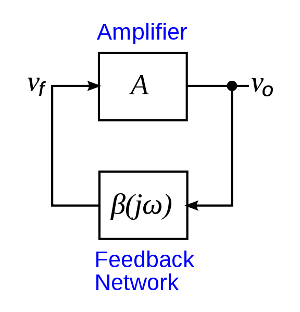
Block diagram of a feedback oscillator circuit to which the Barkhausen criterion applies. It consists of an amplifying element A whose output vo is fed back into its input vf through a feedback network β(jω).

Fig 2.1 Block diagram of a feedback oscillator circuit to which the Barkhausen criterion applies. It consists of an amplifying element A whose output vo is fed back into its input vf through a feedback network β(jω).


As no appropriate external cycle with a period of around 120,000 years capable of driving the climate has been found the first can be ruled out. Therefore is it likely the climate is in some way unstable. So what makes a system oscillate and imposes this kind of cyclic behaviour? The answer comes in terms of the criteria for a system to oscillate in this manner.
Continue reading

Posted in Caterpillar, Ice age | 12 Comments

Toward a new theory of ice-ages I (Introduction)

This was a quick outline of a theory I’ve been developing since the summer on the cause and progression of ice-ages. As I started describing the theory and the background, it mushroomed and spawned into several articles and then  … I hit a snag.
Crucial to my theory was that temperature was controlled by CO2 (but not in the normal way). I knew CO2 lagged temperature, but I kept going hoping I could explain this. Then it all came unstuck, not on the CO2 lag, but when I realised that there were very significant falls in temperature occurring around 16,000 years after the peak of each inter-glacial. (See I’m a CO2 denier) and CO2 did not fall in the same way. So, CO2 could not possibly be causing this cooling, so, CO2 clearly did not directly cause the ice-ages.
(Note in my defence: this presumed CO2 induced positive feedback during the ice-ages is one of the main reasons for believing in positive feedbacks in today’s climate. So, it never occurred to me that it would be so obviously flawed).
I’ve now been thinking about this since Xmas and not really making much progress. So, I have decided to start publishing my articles, knowing the conclusion is wrong, but hoping that the discussions might suggest a way forward to me, or that at worst, they prove useful to others.

Fig 1

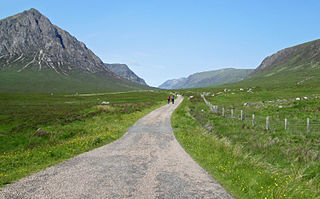
Fig 1.1 A view into Glencoe Valley showing glacial U-shape (source: Dave souza)

Current state of Knowledge

In 1742 Pierre Martel, an engineer and geographer saw erratic boulders in the valley of Chamonix in the Alps and the locals said these erratic boulders were from when the glaciers extended much farther. From that first step, the idea gradually developed that much of the North of Britain, Europe, Asia and America were once under huge ice sheets and that these ice-sheets had fundamentally moulded the character of northern places like Scotland. Today we now accept that U shaped valley, with wide bottoms, steep sides and broken rocky tops that are characteristic of Scotland are a consequence of the Ice-age. However, a few centuries on there is still no real understanding of what causes ice ages. Continue reading

Posted in Caterpillar, Ice age | 19 Comments

More thoughts

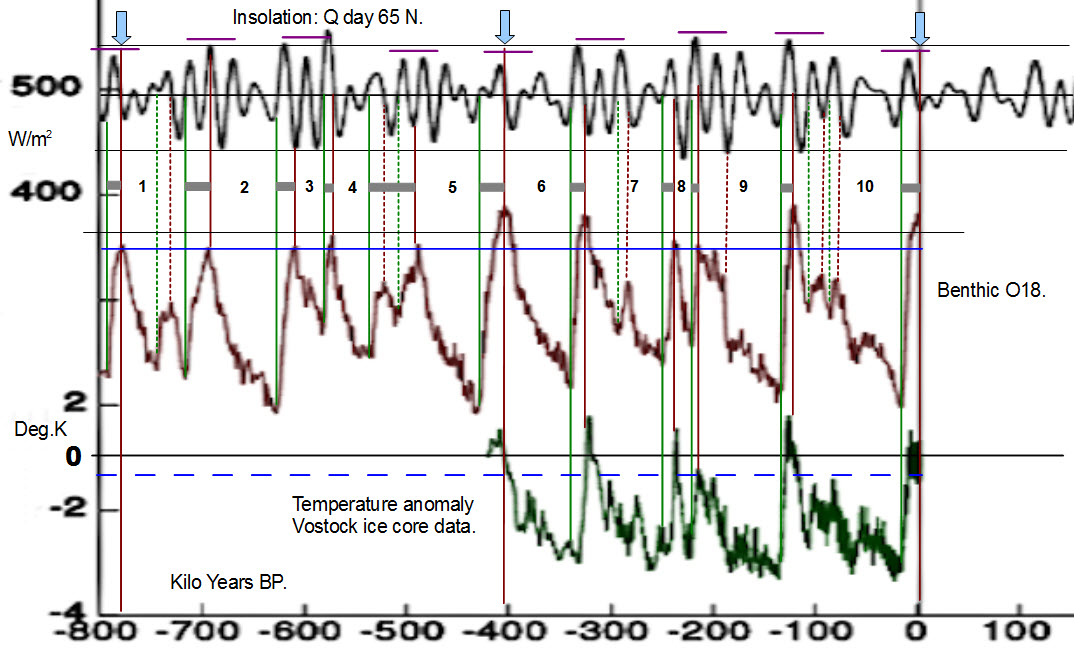
milankovitch-cycles-chart-3Following a few useful comments on the previous post (now I’m a CO2 denier). I went for a walk on out local nature reserve – and unfortunately was distracted by the Lenzie Chainsaw Massacre.
However, I’m now viewing this cycle differently. The key is whether or not the cycle is “triggered” by something else. I had been working under the assumption that something might have been triggering a chain of events which is why we get the sudden rise and slow decline in temperature.
But walking along, I began thinking about the signal being the combination of two other signals: a sawtooth “|\|\ ” and a regular cycle. “∩∩∩∩”. In some way the temperature change was becoming more susceptible to the milankovitch cyle in proportion to the scale of the saw tooth.
I already knew that the ups and downs of the decline, tended to coincide with Milankovitch cycles (see 50 – 100k BP in the above). But I was still trying to adapt this to a trigger hypothesis.
And then it dawned on me that “trigger” and the “combination” hypothesis, would produce different results. When they don’t start at the same time, the trigger hypothesis says that it will either trigger or not. Whereas the combination hypothesis says we should get an irregular waveform. (the start of the sawtooth will not coincide with the rise of the ∩, so we get half a ∩ instead of a nice whole ∩)
And looking around 580k BP, we do see what could be this irregular waveform and again at 730k BP.
So, I might very well be throwing out everything I’ve written since the summer (albeit more effort has been spent in thinking than writing).
Of course – too early to say what could be causing this sawtooth wave and really difficult to understand how we could get controlled positive feedbacks modulated by this sawtooth wave. However, whilst I feel like I’ve had a “go back to go” card, it is definitely a step forward (joke).

Posted in Climate, Ice age | 4 Comments

I'm now a CO2 denier

Over the years, I’ve learnt through bitter experience that “ignorance is bliss” and that if you go and look at an area of climate it always turns out that the scam is much worse than you could have imagined.
I accepted the work of people like Hermann Harde says that CO2 should cause around 0.6C rise in global temperature for a doubling of CO2 but I assumed the real contention was the amount of feedback. Continue reading

Posted in Climate, Ice age | 60 Comments

A Global Epidemic Of Data Tampering At The US Government

This is one of the most blatant frauds in history. The evidence is so clear and unequivocal that it beggars belief that those involved are not already serving jail sentences.
NASA have a clear self interest in promoting environmental doomsday as they get a lot of money off the back of these scares for yet another space program to launch another satellite to look down on earth to “monitor” whatever the latest fashion is in environmental doomsdays from ozone to acid rain to CO2.
In the UK when it was discovered that bankers had merely fabricated the LIBOR inter bank lending rate – the police investigated, bankers were in court billions of fines were imposed and ministers were forced to resign.
But when it comes to this scam – the scam Steven Goddard and many other people have repeatedly shown this to be a fraud, yet not a single person in the “establishment” has taken this clear unequivocal fraud seriously.
Which shows they all have their snouts too deep in this scam to admit the truth.
read the story at: https://stevengoddard.wordpress.com/2015/02/01/a-global-epidemic-of-data-tampering-at-the-us-government/
NB. This “reblog” did not work the first time. That attempt seems to be caught someone in limbo, so this is a copy of my comments and a link to Steven’s article.

Posted in Climate | 4 Comments

I said there would be powers cuts this winter – and we've just had one!

Lenzie during the power cut (note the glow from nearby conurbations)

Lenzie during the power cut (This is in special night mode so it was a lot darker and note the snow (children won’t know what snow is a nd the glow from nearby conurbations)


At around 9:05pm tonight as I was pouring a drink … the lights went out. In October when Didcot had problems I said:

This means Scotland has a “reasonable” chance [I guess 50:50] of at least one major conurbation facing an evening without power typically in January – March.”

I just didn’t think we would be suffering a power cut!
After two failed attempts the power finally came back on at 10:20.

Posted in Climate | 3 Comments

A strange week.

I’ve spent most of the week surveying part of a local nature reserve. During that week, I’ve had dozens of people coming up to me to complain about a group of “environmentalists” destroying the environment. It got so bad, that I was glad when it started pouring down rain as that meant I would be left alone with nothing but my own thoughts and the distant buzz of environmentalists chainsaws destroying woodland.
People like this nature reserve because it’s a mile long walk through a mix of trees and open heath. And it used to be a magical place to take children because although relatively small, it used to be easy to get lost passing through the dense woodland and then Scottish moorland – all within a 10minute train ride of a major Scottish city.
However, it seems that someone has decided that this area should not be woodland because presumably they have decided that it is “supposed” to be open heath.
Paradoxically, much of the area used to be naturally heathland – that is until they built the path through the reserve. Before this path, much of the area was naturally free of trees – presumably because the area was frequented by deer which ate the young saplings faster than they sprouted and this kept most of the area from turning to woodland.
But it all changed when they built the path. Presumably because the dog walkers scaring away the deer. This meant that over the last decade the trees have grown up along the path, and so I didn’t see a big problem cutting down these trees where the deer no longer visit along the path.
So, I just assumed this is what was going on. But at at times, almost everyone passing was stopping to ask whether I had anything to do with this tree felling. So, with so many complaints, I eventually I went to look. It turns out that not only have they been clearing the trees along the path where it used to be clear, but they have also been clearing much of the area of woodland that was marked as woodland on the 1850 map. So although the trees themselves are not this old, it seems they have cleared an area which must have been largely untouched woodland dating back at least 165 years.
The irony, is that this area where they are clearing is well known as an area the deer shelter in during the day. So, by clearing this section, they are destroying the shelter for the deer and with less deer to keep the trees from growing on the boggier areas, the more these boggier areas will turn to the very woodland the environmentalists don’t seem to want.
It just seems to me to be pointless destruction – and the irony – pointless destruction which I presume has been carried out to “save” the environment.

Posted in Climate | 1 Comment

A problem with CO2

CO2 and Temperature as derived from Vostok ice core (shown with time going forwards).


My grand theory of the causation and progress of ice-ages was making steady progress before Xmas until I hit a small snag: CO2 levels do not work as a greenhouse gas! But neither do they just respond to temperature!
I’ve been thinking about it for a while without making progress, so I’m hoping that writing this article will stimulate some ideas to get around the log jam.
To recap re the evidence. We have a 400 thousand year record in the vostok ice as shown above. From this we can derive changes in CO2 and temperature (But please note both are proxies and not direct measurements as Salby showed). Continue reading

Posted in Climate | 6 Comments

Pope denies god

The Denier (And the windmill - the new symbol of catholicism?)

The Denier
(And the windmill – is this the new symbol of Catholic faith?)


I read today the headline: “Pope Francis says climate change is mostly man-made.” In other words, he is denying what is technically called “natural variability”, but in a previous more religious age was called “acts of god”.
And to make it all the worse in “Canute”** style he intends to issue a papal bull denying the power of god over the climate and decreeing the omnipotence of academics who have as yet proven incapable of predicting the climate.
So, if there is a god – how will (s)he react to this slight against his (her) power and authority?


**Unlike this pope, Canute was a wise king who was fed up with his advisers who tried to tell him he was all powerful. So, to show them how idiotic the idea was of a mere human having control over nature, he had himself sat down before the natural variation we call a rising tide and commanded it to cease.
In one simple action he showed his own humility, his wisdom and the stupidity of his advisers – a lesson this pope needs to learn.

Posted in Climate | 4 Comments