To the one I love

So no excuses for sitting on the couch
watching TV or reading a book,
get that heart racing as


So no excuses for sitting on the couch
watching TV or reading a book,
get that heart racing as
In the previous introduction and article on cycles I covered ground that will be familiar to many. In this article I want to look at Hadley cells and start to consider other ways the planet might operate.
See also:
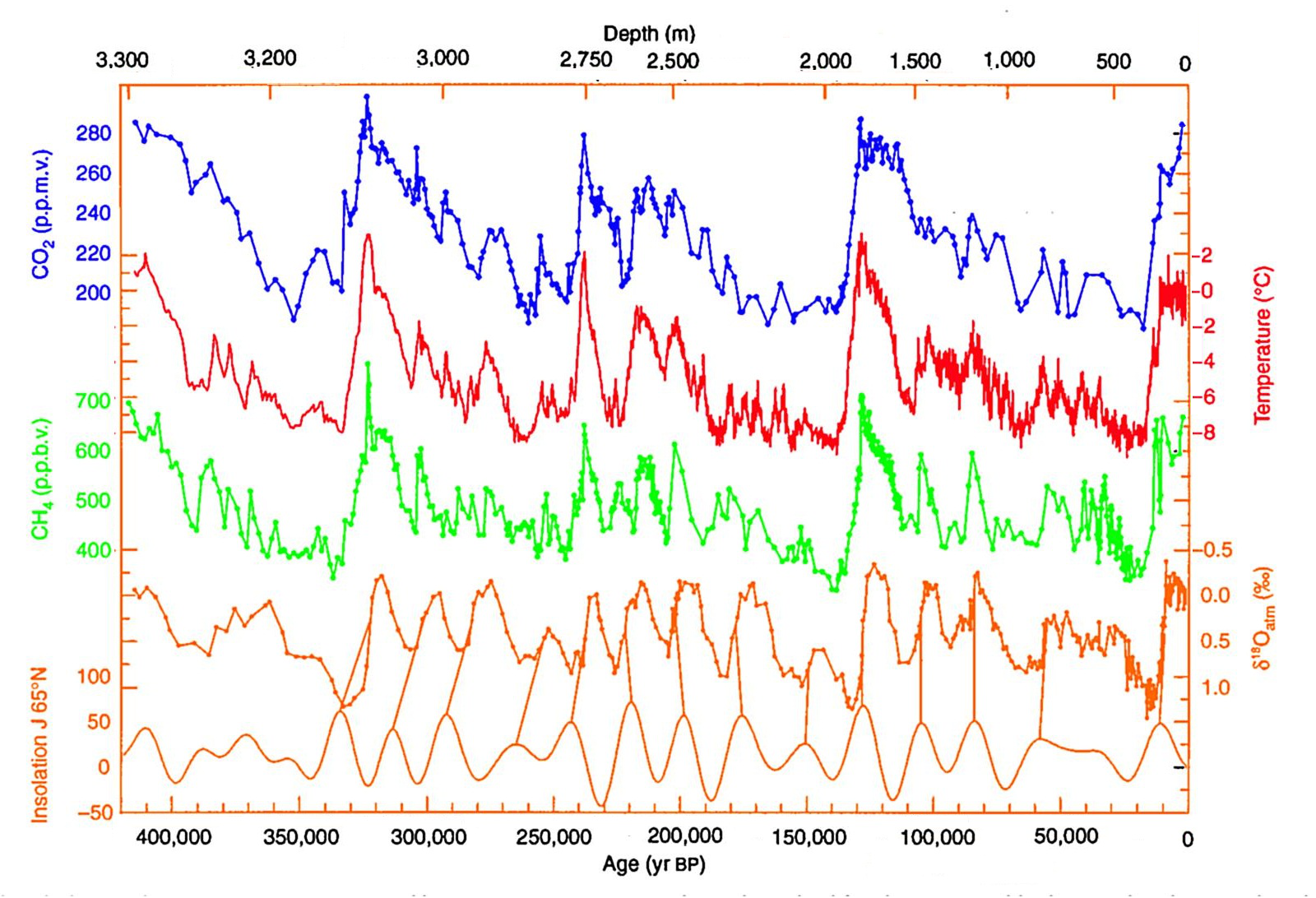
Fig. 20 Vostok ice core showing CO2 (blue), proxy temperature (red), CH4 (green), %O18 (upper brown), Insolation (lower brown)
I’m now going to present a theory that in large part supports that view
[As I detailed in my previous article “Now I’m a CO2 denier“, I failed to fulfil this intention because CO2 is not correlated with temperature around 16,000 years after the inter-glacial peak.] Continue reading
So far we have discussed ice-age cycles as if there is one and only one type of cycle of around 100k years. In this article I want to put flesh onto that skeleton and look at the variety of cycles and non-cycles that can be found.
See also:
Like the ice-core estimates of ancient temperatures, the ratio of Oxygen 16/18 in Benthic provides another way to estimate temperature, but over a much longer period and below is a typical result:-

Fig 10.1

CO2 and Temperature as derived from Vostok ice core (shown with time going forwards).
After discussing how reducing CO2 could modulate H2O to produce a drier and therefore colder climate I want to review the evidence for that colder climate in the ice-age.
In the last article (How CO2 could control climate) I introduced the idea that we live in an effective CO2 desert geologically with unprecedentedly low levels of CO2. And how even a relatively small reduction in CO2 could dramatically affect plant life pushing plants away from the drier areas. This in turn would lead to a reduction in transevaporation from plants, a drying of the atmosphere a reduction in the necessary greenhouse warming effect of water vapour and a decrease in temperature again leading to less plant growth and less water. In effect, reducing CO2 might not on its own have the necessary greenhouse effect to alter the climate much, but its effect on plant growth and through in water vapour might.
See also:
In the 1950s whilst most people accepted that the world had had ice-ages it was difficult to discern any details except the scant information left by terminal moraine giving an indication of the greatest advance of the last ice sheets.
The in 1947, the nuclear chemist Harold Urey discovered a means to estimate ancient temperatures from the oxygen built into fossil sea shells. This relied on changed to the (O18/O16 ) taken up by the organism and then preserved in its shells. And as we have seen this can be used as a proxy thermometer.
Then a geology student Cesare Emiliani, working in Urey’s laboratory at the University of Chicago measured the oxygen isotopes in the microscopic fossilised shells of foraminifera, a kind of ocean plankton. These shells could be found in clay cores extracted from the sea bed. Moreover as they also contained carbon he was able to use Carbon 14 dating for the most recent layers from which he could estimate the rate of deposition. Together the C14 and O18/16 provided the first detailed estimate of temperature variations during the recent ice ages. Continue reading
This article explores how changes in CO2 might be linked through plant growth to global water vapour and thus provide a potential indirect mechanism by which CO2 might influence climate.
So far I have introduced the concept of climate cycles and how positive feedbacks must be present in order to have the ice-age cycles. I have also shown that in interglacial periods either additional negative feedbacks come into play or the positive feedbacks disappear so that further warming is very hard.
In Global warming and earthquakes I introduced a mechanism with a delay sufficiently long to provide the timing mechanism creating the roughly 100,000 year ice-age cycle we see at present. In that article I suggested CO2 was released in great quantity, but I did not provide any means by which that could influence climate except the very small greenhouse effect of CO2.
See also:
After Booker’s article in the telegraph: “The fiddling with temperature data is the biggest science scandal ever“, based on Paul Homewood’s work exposing what appears to be fraudulent changes made to S.American temperatures, things are certainly heating up. Continue reading
In this article I explain why the evidence shows we are unlikely to get runaway global warming in the present inter-glacial period and propose a simple mechanism.
So far I have proposed a timing mechanism explaining the long period of the ice-age cycle, a means by which CO2 (or other gases) could be released during this cycle due to expansion and contraction of the earth’s crust and then I have look at feedbacks and climate stability explaining that for the climate to go through cycles there must be positive feedback present.
See also:
To go back to figures 2.3 & 2.4 (see Criteria for Cycles) we saw that in a typical astable oscillator, the system can have very high levels of feedback such that theoretically it would continue to increase without limit, but that in a practical circuit, the signal is normally limited by the power supply voltages. Continue reading
The last article discussed negative and positive feedbacks in the climate. Now I want to see how these impact the stability of the climate and also how the stability of the climate can tell us what kinds of feedback are present.
See also:
I introduced the idea in the overview of feedbacks that negative feedbacks are rather like a driver on a road constantly correcting any small veer to one side or the other. I then suggested that positive feedbacks produce the kind of effect that would occur if an ordinary driver got into a car where the steering wheel acted in reverse. So that as they turn to the right to correct a drift to the left, rather than the car going right as intended, the car goes further and further to the left. As a result almost all normal drivers getting into such a car will go off the road and so would a climate with large positive feedbacks.
In general climates with positive feedback tend to be unstable and the higher the feedback the more unstable they become. Continue reading
Although feedbacks and the resultant climate sensitivity are widely discussed, it is done so with reference to CO2 and warming. During the ice-age cycles feedbacks act when the temperatures are both cooling and warming. This will be obvious to many but as even sites like the UK Met Office focus almost exclusively on the effects of increasing CO2 and ignore feedbacks during cooling, to ensure everyone understands the concept of feedbacks relating to a complete ice-age cycle irrespective of whether CO2 is driving it, I will quickly cover the topic. Note, I’m not trying to introduce anything new or novel here.
See also:
I briefly introduced the theory of feedback in relation to a circuit in the article on cycles (see fig 2.1) but how do they manifest themselves in the real world?
All life is subject to feedbacks. When driving the car, if we are tending to veer to the right, we turn the wheel slightly to the left to bring us back along our intended route. In such a way, even though the car will be constantly subject to various forces such as wind, camber, etc. which constantly tend to push it away from the intended direction we then act in the opposite direction to bring it back to our intended route. Moreover, the bigger the deviation, the large we turn the wheel.
This is a form of negative feedback. And as shown below in a schematic for climate temperature if the climate is subject to negative feedback, any change that tends to warm the climate is reduced is scale so that it does not warm as much as it would without these feedbacks. But also any change that tends to cool the climate is also reduced in magnitude. So negative feedbacks tend to reduce the impact of any change.

Fig 5.1 Effect of negative feedbacks is to slow down or reduce warming AND to slow down of reduce cooling.
In the last article I showed how the temperature change between Glacial and interglacial was sufficient to cause up to 2.3km of crust to be forced down into the earth’s core. In this article I examine how this could affect climate.
See also:
A windmill takes energy from the wind and in so doing it opposes its motion. To enable that, each windmills has several hundred tonnes of concrete make from cement which is in turn produced by heating limestone rock.
The breakdown of calcium carbonate from heat is called thermal decomposition and the equations for this thermal decomposition of calcium carbonate are:
calcium carbonate  calcium oxide + carbon dioxide
CaCO3 CaO + CO2

Fig 4.1. Geotherm showing temperature and depth of decomposition of Limestone
