New Sceptic Currency

I was reading about a site that allocated crypto-currency to users … and I began thinking about how anyone redeemed that “money” for anything and started thinking of a model.

Let us suppose that I create a virtual currency called a “skep”. Let me also suppose that I created a mechanism by which people could add to their website a way to “earn” skeps (a short bit of code which created a “donate” button for holders of skeps.

Now, we have a mechanism whereby someone with a website can earn “skeps”. So let us say that originally there are 1000 skeps, and that a website earns 100 of them. How do they use these skeps? The obvious solution is that they could just give them to other people who write blogs … (who add the software). But an alternative is that they “auction” them on a host site … this would be a site where people who want to donate to websites, buy skeps in order to have skeps to donate to website holders.

And this provides a way to get the whole thing going at zero cost …

  1. Create a website for the skep
  2. Get users to sign on for “free” skeps (assigning a nominal value to them)**
  3. This will then encourage websites to provide “donate” buttons ….
  4. After a while, those who have been “donating” skeps to websites will need to replemish their supply and thus they will need to “buy” more and those who have received skeps will wish to sell them.

**There would have to be a lock to prevent buyers trying to sell these free skeps without donating them.

Auction mechanism

Anyone with skeps who wishes to sell some, merely states the quantity and price (in local currency) that they are willing to accept.

Anyone wishing to buy skeps, merely states the quantity and price (in local currency) that they are willing to accept.

If there is a buyer who is willing to pay the same or more than any seller, then the transaction immediately completes (up to the point the seller or buyer has reached their quantity limit).

Excess price

If the seller is willing to accept $0.98 per skep and the buyer willing to pay $1.00, then for every skep transferred, there is an excess price of $0.02. The simplest way to deal with this, would be to make the actual transaction price $0.99, so that if the buyer wanted 100 skeps at $1, if the seller were willing to accept $0.98 then they would get 100 skeps at $0.99 …which would be awkward as there is now $1 left which cannot be entirely fulfilled by skeps at $0.99 (101 skeps at $.99 would leave $0.01 that has not be “spent”).

So, another way to deal with this, would be to set the price at the value at which the buyer is willing to buy. Another way, is to pick the unit price that is closest to the mid-way point, above the seller’s price and which allows the buyer to purchase an integer number of skeps.

Another approach, is to charge the buyer the price they offer, give the seller the value they demanded, and to use the excess price to effectively create additional skeps 🙂

Speed of transaction and price

But the key to the bidding system, is that it encourages some people who wish to buy or sell large number of skeps, to set a price slightly above or below the current transaction price, in the hope that they can “get a better deal” – but at the cost that they have to wait some time to buy sell. This encourages a situation where some people are always available to buy/sell if a seller/buyer is willing to take a price hit and bid low/high enough for these long term buyers/sellers. This is important because many people want to be able to immediately buy or sell.

Why then don’t we just fix a set price? The reason is that if you simply set a fixed price, then in order to get the system “kick started”, by giving away free skeps, you are literally giving away money.

Usage?

I’ve been wondering for a while how it might be possible to give micro-payments to websites as donations. Let us say that a typical magazine at £5 is worth 100 website articles, then the typical value of website article might be £0.05. So, we want a way to donate money in perhaps £0.05 “units”. Or perhaps, more likely, we want a way to vote for articles giving them “donations” based on their perceived value of perhaps £0.01 to £0.09. And, indeed, there is no reason to limit the lower end … so that perhaps a “skep” could be split into “$0.001” or “£0.0001”?

Indeed, if a “skep” had a nominal price of about a pound/dollar, but could be divided as small as the computer arithmetic allowed, then the traditional limit on money being a “whole coin” would practically disappear (except for massive quantities of very minute transactions which would have to be automated and not allocated by a human donating money).

Inflation/deflation

What I find interesting is what is likely to happen to the value of the skep as time progresses. Let us suppose that initially 100 people sign up for “free” skeps with a nominal worth of $1000. Because they had this nominal value, it is reasonable to suppose that many individuals will treat them as if they had a not too dissimilar value. But some, no doubt will take the attitude “it was free and therefore has no value”. If those treating it as “free”, are a significant number of the initial users, we can assume that they will not be purchasing further skeps for actual money, as such there will be an excess of skeps being donated, to the number that are willing to rebuy. As such it is likely the value of the skep will drop.

However, if a lot of new people come in, or the original users feel that it is a good idea and significantly increase the number of skeps they wish to buy, there will be a shortage of skeps and possibly the price may start to increase dramatically.

But there is an easy mechanism to stabilise the value of the skep … that is to put in an upper price, where if buyers bid over this price, and there are no skeps available, then more skeps will be created automatically. In addition, there could be a lower limit whereby all skeps will be bought at that price, but this requires a central source of funds. Where can this come from?

Let us suppose that the upper limit is $1, and that we initially start with 1000 skeps, then for each skep automatically created, the central fund will gain $1. Let us suppose that after a while, we have a total of 2000 skeps in circulation. At this point, it is possible to set the lower limit whereby all skeps will be bought as being $1000/2000 = $0.50, because there is $1000 in the kitty and that is enough to guarantee a price for 2000 skeps of $0.5 per skep.

If however, we automatically create another 4000 skeps, we now have $4000 in the kitty, and that is enough to guarantee a lower price of $0.80 per skep. So, the guarantee price can rise as more skeps are created. That may be enough fluctuation to make the bidding system work smoothly. Therefore if further skeps are automatically created, the excess money could be redistributed to those selling skeps as a “bonus”.


Posted in Economics, Uncategorized | Comments Off on New Sceptic Currency

Change of URL

After a while using the domain: Scottishsceptic.co.uk I’ve decided to change to scottishsceptic.uk. This however, won’t be the biggest change as I’m planning to launch a new “in house” journal for sceptics at the beginning of 2020. That however may keep me relatively quiet on this blog.


Posted in General, Uncategorized | Comments Off on Change of URL

Google you’re barred

Google is a politically active organisation which truly represents the 1984 “Big brother”: invading everyone’s life and socially manipulating society towards its own vile politics & profit.

Before I realised that their political manipulation of search results wasn’t just a mistake but an intentional policy, I tried to get my sites onto their vile search engine. Today, I’ve decided I will now try to block big-brother-google from accessing my site.

If you’re not convinced bing “project veritas” where a google insider reveals they have planned to stop Trump getting re-elected. And this is not an odd employee dabbling to bury one site. This is an internal policy of big-brother-google to bury ALL sites which it politically dislikes.

So, I’ve been looking into how to block Google Continue reading

Posted in Uncategorized | Comments Off on Google you’re barred

The Price of Fish III

In the price of fish II I took the general concept of two societies with different costs of essentials (fish) and derived a relationship between fish (essentials) and shell necklaces (luxuries). This showed that the two were related in value through the rate of production of each. Or to turn it around, the economic resources used to gain them.

To summarise the view of most economists on energy, they are working under the delusion that we have a free market for energy! That is: that if the price of energy is too high then people and companies will simply find an alternative good to buy. That is because they view energy as simply another good which the consumer is free to buy or not to buy as they chose. However,what I’m asserting is that energy is an essential part of the economy, and that consumers and producers may be able to chose the form of energy they use (gas or electric heating), but for the most part, the energy consumed in producing goods and supplying services cannot be replaced by non-energy goods.

Thus energy is not something whose price works according to the normal laws of economics, instead energy is a critical “control knob” of the economy whose long-term price is a function of the economic cost that has to be scarified in producing that form of energy.

Interestingly however, I’ve previously stated that energy is a constraint on the economy, but I’ve now realised that within that model in Fish I & II, there is another constraint at work. In the primitive society that constraint was the idea that there are only a certain number of hours that each person could work each day.

Thus if gaining essentials took twice the effort (which equates to twice the cost), then this directly took away economic activity for producing luxuries (consumer goods). Or to turn it around, the reason that the economy has grown, is that the time spent producing essentials like energy and food as a fraction of the economic activity has reduced year on year allowing us more resources for producing luxuries.

However, this is a more complex limit on the economic output than I was imagining. It now says, the output of an average worker is limited by the average time workers spend producing essentials, freeing up time for luxuries.

At the moment that time spent in bare essentials is 1/4 of the working time or approximately 1/8 of the total available time (half the time we could be working,  in the modern world, is spent not working – or 40hours a week is only half the possible 80hours a week).

As I found in fish II, that suggests that if energy costs quadrupled, the economy would collapse if we work the same hours a week. However, if the cost of energy/food were to go up 8x, then these rough figures indicate that human activity to survive would require 80hours a week and even then it would likely result in mass starvation.

Doubling & trebling energy costs

But let us start looking at what happens to the economy if we modestly double energy costs. At present energy & food costs are 1/4 of the economy. Doubling energy costs, has a feed through effect on food, so that effectively all food and energy costs double, and that then means twice the economic resources go to food & energy as present. That also means that rather than 3/4 of the economic activity working to produce luxury consumer goods, that only  2/4 of the economic activity is in producing consumer goods. That shows that the economy will shrink by a 1/3. If however the cost of energy trebles, a that implies 3/4 of the economic activity on essentials and 1/4 on luxury consumer goods. That implies the economy drops to 1/3.

To even consider this may sound crazy, but raising the cost of energy by at least double is exactly what treacherous May was proposing with her undemocratically passed sneaked through massively costly “zero carbon by 2050” debacle. If that is “achieved” by 2050, that means between 3 to 6% reduction in the economy each year. That’s a total cost of between £5 and £10 trillion in the UK. In terms of cost per household, that is around £185,000 to £370,000 per household. (I had guessed around £200,000 per household!!)

As of April 2019 the average house price in the UK is £228,903. In other words, the average cost of the “zero carbon”, is that most people won’t have a house. That doesn’t mean that they will be living in rented accommodation. Instead, it literally means they won’t have a house. In simple terms the economy will deflate until we have the wealth that was available in the decades after WWII. Most people will not own their own home, the homes that people live in will be a lot smaller with many people sharing.

“Achieving” this supposed “zero carbon” target will result in decades of economic decline, the like of which the UK has never seen since … probably the black death.

On the brighter side, I think it would be possible economically to shrink to post WWII levels. But politically I think it would be completely utterly impossible to achieve.

Posted in Enerconics | Comments Off on The Price of Fish III

SO2 caused the post 1970s warming

It’s been a while since I originally showed the geographical correlation between areas that used to produce SO2 in the 1970s and the hotspots that showed post 1970 warming. (link)

This also explains why most of the warming occurred over land and in the northern hemisphere. However, I thought I would revisit the subject when  I spotted a comment today on WUWT

by Chaamjamal:

Warming is seen mostly in winter months and not in summer and mostly in nighttime daily tmin and not in daytime daily tmax.
In both hemispheres.

https://tambonthongchai.com/2019/02/12/australia-climate-change-daily-station-data/

https://tambonthongchai.com/2018/04/05/agw-trends-in-daily-station-data/

This is very interesting, because before the clean air acts, the main pollution from SO2 from electricity generation would certainly have occurred in the winter months, and the main time of release would be day time. The second didn’t immediately fit in with my idea that the pollution persists several days “downwind” and used to cause cooling … until I realised that the cooling was caused by the increase in cloud reflecting sunlight. And that this impact is obviously greatest during the day.

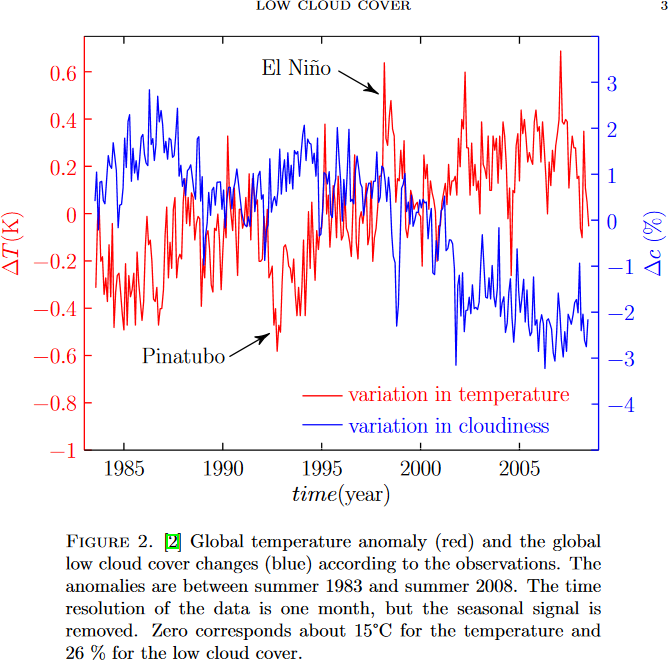
This link between temperature and cloud is indeed what another recently WUWT publicised article written by a Finish academic also shows. NO EXPERIMENTAL EVIDENCE FOR THE SIGNIFICANT ANTHROPOGENIC CLIMATE CHANGE as shown in the following graphic:

This neatly links the SO2 to temperature as it does appear to show that low cloud level is the main driver of global temperature. (With the proviso, that I haven’t yet seen the evidential basis so have to assume it is correct). Coincidentally it also suggests that doubling CO2 will cause less than 0.5C warming

Adding this together the geographical correlation of warming, the clear time dependency over decades showing warming after the 1970s tailing off to the pause, the increased temperature effects in the winter when heating was in greatest use in the heavily populated northern hemisphere, the correlation between cloud and global temperature, I would say there is a pretty cast iron case linking SO2 pollution to the short-term warming between 1970 and 2000.

Time to stop saying “SO2 (or related smog-causing pollution) may have causes 1970-2000 warming” and time to assert it clearly did.

Publishing?

It is utterly pointless to attempt to publish something like this. I have watched those that have wasted their lives attempting to get things published and then found that they have wasted 5 years of constant effort trying to get something into one of the climate cult controlled journals, only to have it “debunked” by multiple sham “papers” before it was even published. Publishing in an academic-climate-cult publication is a waste of time and just creates a delay getting it published to the people who will want to read actual science on the internet. Moreover, no one pays me for my views, so I have not the slightest interest in publication.

I am interested in climate because it interests me.

But most importantly, if the global warming scam could ever be silenced by science, if it were really about science, it would have died almost as soon as it was born.

Posted in SO2, Uncategorized | Comments Off on SO2 caused the post 1970s warming

Enerconics v. Spontaneous Innovation

This article focusses on one of the assumptions of the theory of enerconics which is whether innovation drives economic growth or whether we innovate as a result of economic growth.

Continue reading

Posted in Enerconics | Comments Off on Enerconics v. Spontaneous Innovation

The future of academia

A few years ago before my son went to University I talked about the fact that much of what universities do could be automated using online media. I was told in no uncertain terms that I was wrong. A few years later, I heard that he was doing almost all his course work from the library because almost all lectures were available online.

The simple fact is that in most courses, the vast bulk of material taught in first and second year does not need a lecturer, does not need a tutor, nor even for the student to be on the same continent as any of the academics. Yes, there are some essential elements of science like lab work that cannot be done at home, and whilst arts have no labs, unlike sciences which lend themselves to multiple answer quizzes as there is usually only one correct answer, arts will continue to need essays marked. So, yes academics will continue to be needed to run labs and mark essay-like course work. But why hire a third rate academic for your University to run a first year course, when you can buy in that course from first rate academics using the very best visual presentation media?

As such, the bulk of “normal” teaching is going to become increasingly delivered through new media without the need for academics. And as this becomes the norm, this form of delivery will become cost effective for smaller and smaller classes and more and more niche subject until there are whole University courses in “standard” subjects that barely need an academic.

This article tries to explore the implication of this change

Continue reading

Posted in Academia | Comments Off on The future of academia

The future of the press and media

50 years ago, anyone who wanted to sell a house, a car, or advertise a job, had very little choice other than to pay the enormous costs of advertising demanded by newspapers. And anyone looking for a job, a house, a car, had very little choice but to continue to buy newspapers until they found what they wanted … by which time they probably needed something else. So, newspapers were rolling in money from advertising and likewise there was plenty of money for journalists to actively go out and research news.

Then, along came linotype printing, which dramatically reduced the cost and quality of printing enabling specialist magazines like autotrader (which funded the Guardian). These took away some advertising revenue, but then the real calamity came: the internet. Suddenly, anyone who wanted to buy or sell could go to online sites like ebay which asked a fraction of the costs of traditional newspapers and the result is advertising revenue for newspapers plummeted. The result that journalists were let loose in their hoards. The result was papers started being run on a shoe string, so that most of the journalists left had no time or money to do real investigative journalism and instead resorted to copy-n-pasting press releases. That meant that so long as the originator had even vaguely credible credentials (like an academic) they could get whatever non-science press releases they wanted into the media. That in turn fed a raft of non-science campaigns like the climate cult & anti-fracking and generally let to a proliferation of “fake news”.

But as a result of the huge cost cutting, over the last couple of decades, the press has been quietly changing. Many local papers that used to do real journalism have effectively folded to become regionalised syndicated snooze-papers carrying much the same articles across whole areas with a bare smattering of local material. Others locals have had to stop trying to be daily papers and moved to weekly, and others closed entirely.

However, apart from the independent (now a glorified blog), the names in the national press in Britain has very much the same names as it did from before the internet. Given the dramatic changes in local news, the lack of change at the national level can’t be sustainable.

This article is my attempt to think through what is likely to happen. Continue reading

Posted in internet Revolution, media, Politics | Comments Off on The future of the press and media

The Value of fish II

In the Value of Fish I considered two societies where the only difference was the rate at which they could secure life’s necessities (9 fish a day). In this article I want to generalise that concept.

Let:

  • d = average number of hours a day
  • n = quantity of necessities that are needed
  • rn =the rate of acquiring necessities
  • ri =  the rate of producing consumer good i

The time taken to produce the day’s necessities is = n/rn

The available “luxury time” is given by (d – n/rn) where d > n/rn

The number of consumer good i that can be produced in a day is  ( d – n/rn) . ri

The quantity of necessities which can be produced in a day is  ( d – n/rn) . rn

Therefore if we take that a day’s work is equal then:

1 day’s available goods = ( d – n/rn) . ri  . goodi = ( d – n/rn) . rn . necessity

Thus the ratio between consumer value of item i and necessities is given by:

( d – n/rn) . ri / (( d – n/rn) . rn ) =  ri / rn


Or to put it another way, the value of a necessity in terms of consumer item i is given by:

vn = ri / rn  vi

Thus if the rate of producing a consumer good (shell necklaces) remains the same, but the rate at which the necessities of life doubles (from 1 fish/hour to 2fish/hour), then this means the value of fish relative to shell necklaces halves.

Because energy is a necessity in a modern economy, this also implies that the cost of energy is directly proportional to the economic activity (here given as hours of work) required to provide that energy. It also implies that if a quarter of the GDP is tied up in producing necessities like energy, then the economic activity involved in producing energy is 1/4 of the total activity and that if the price of energy doubles, then the economic activity used to produce energy will double to 1/2 the economy meaning that there will be a reduction from 3/4 of the economy producing consumer (luxury) goods to 1/2. It also means that if 1/4 of the economy is currently involved in producing necessities, then if the cost of necessities like energy (and food which is closely linked to energy costs) were to quadruple – as I think is necessary to get “zero carbon”, then basically there will be no other economy other than necessities and our modern economy will basically catastrophically collapse.

In other words, if energy costs were 4x their present value, it would be IMPOSSIBLE to run anything like our present economy and e.g. the number of hours worked by an average person would need to MASSIVELY increase. That means the effective end of free time, which in turn means the end of any opportunity for almost all individuals to engage in political campaigning such as these “climate action”. It also means, there will be next to no TV, next to no press, next to no cinema, so the wholesale wipe out of the present media, present groups like Greenpeace, Friends of the Earth. Not quite the stone-age but certainly a lot more like Dickensian London in terms of economics, culture, politics and free time.

Enerconics

But, more importantly than the mere total collapse of the economy as we know it, what about the idea that economies can be measured in terms of energy rather than money? Contrary to my earlier belief, there is not a direct relationship between the two, rather the availability of energy and economic activity are proportional to each other with that proportionality being determined by the ratio of the rate of production of energy and the rate of production of consumer goods.

If both rely on the same technology, then the relative value of energy and consumer goods will remain. If however, there are fundamental changes in the way we obtain energy, that significantly reduce the cost of energy, or as is being proposed now, that the cost of energy should dramatically rise, then the value of energy relative to consumer goods will dramatically change. A reduction in energy costs relative to consumer goods expands the economy, an increase retracts the economy. As such changing energy costs explain the rise in the scale of the economy, but the key to using energy as an economic unit of value, is in knowing the relative cost of producing energy compared to producing consumer goods.

Posted in Enerconics | 2 Comments

Breaking car windows underwater

If crossing a river in a car in anything but ideal conditions, or worse if you get caught in a flood, you would be insane not to open a window as the situation can quickly become life threatening with the car being swept into deep water after which it is usually impossible to open doors and windows.

To put it simply, if you get into deep water and have not opened a window, you will most likely drown, and whilst there are a number of manufacturers pushing tools they claim will break windows, I’ve seen no report that doesn’t appear to have been placed by the manufacturers to substantiate that they are any help whatsoever.

But whilst the key to escaping a vehicle in deep water is opening a window ASAP, what would be the best strategy to escape if you were caught in a sinking car?

Continue reading

Posted in Uncategorized | Comments Off on Breaking car windows underwater