Mann: Trump "It’s an all-out assault on Earth"

Back in December 2014 I wrote an article entitled: “Inhofe: finally the big guns are firing!


I guess those shells have finally landed. Today I heard this:

Climate scientist Michael Mann’s new book says climate denial is ‘driving us crazy’“This is what happens when ExxonMobil and the Koch Brothers run the show,” said Michael Mann,
….“It’s an all-out assault on Earth,”

Notice how the simple expediency of removing funding from bloated and corrupt government departments who waste their time on bogus hockey sticks, hiding the decline and fabricated graphs like this:
nasasurfacetemp1981-1999-2014… becomes an assault on the whole planet. Bring out the straight jackets!
Or to use another of my Metaphors the kick from Climategate has finally reached Michael Mann’s tiny brain and it’s clear his eyes are watering:

An overview of the political process from Climategate to present.

An overview of the political process from Climategate to present.


At this point I want to again thank all the individuals both sceptic bloggers and those who supported us and made this possible. I can’t repeat this sentiment often enough:

Never before have so few achieved so much with so little … except that is the whole of science and mother nature on our side.

Posted in Climate | Comments Off on Mann: Trump "It’s an all-out assault on Earth"

Budget cuts at EPA and NOAA

As expected the cuts are beginning. We’ve already heard that NASA climate is effectively closing, now we have more details at NOAA and EPA.

Trump administration to cut climate change science agency NOAA’s budget by almost 20 percent claims new report

Read more: http://www.dailymail.co.uk/news/article-4280688/NOAA-budget-cut-Trump-administration-memo-says.html

Trump’s Proposed EPA Budget Cuts Target Climate, Clean Air, Clean Water Programs

http://www.huffingtonpost.com/entry/trumps-proposed-epa-budget-cuts-target-climate-clean-air-clean-water-programs_us_58b895bbe4b05cf0f3ff2c41
With anything like this, whilst the cuts are necessary, it always affects individuals and their families so I will reframe from further comment.

Posted in Climate | 2 Comments

1 in 6 jobs "at risk" in Scottish unreliables is not enough

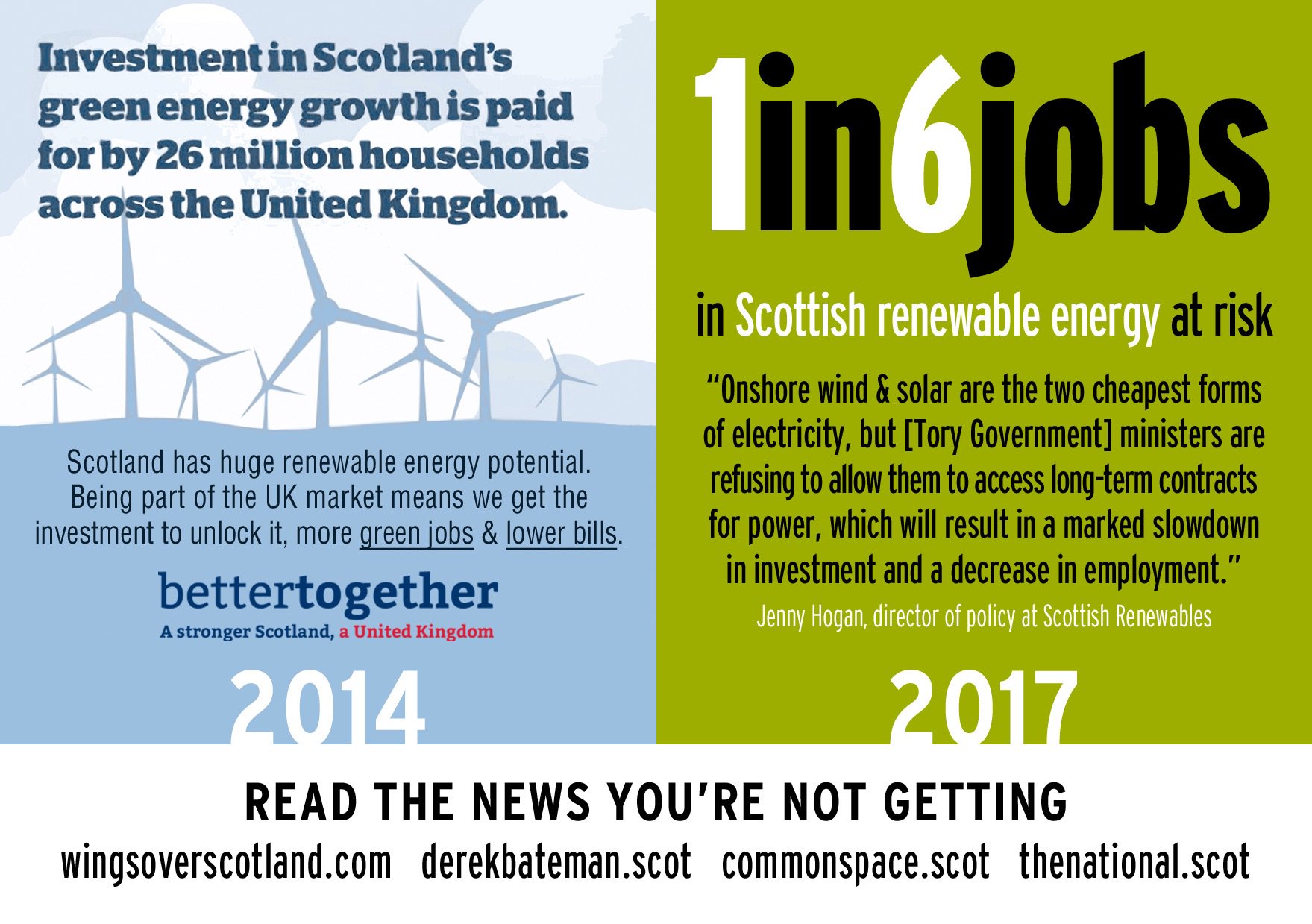
I had to share this tweet:

C6EyrU3XQAILnWS.jpg largeOf course I will not stop trying to end the unreliables scam until every one of these bird/bat mincers has been torn down and those who pushed the scam have their names blackened as the scum of history.

Posted in Climate | Comments Off on 1 in 6 jobs "at risk" in Scottish unreliables is not enough

Probability waves & time travel

As anyone who has read above the wave particle duality “theory” in physics will know, light is supposed to be both a photon and a wave. Likewise an electron is supposed to a particle and a wave. This is because both of them exhibit wave like behaviour but also interact as if they were particles as discrete impacts and energy transfers.
Of course it’s a load of rubbish … because in order to make the theory work, once a “photon of light” is emitted from a particle, it continues to spread out, and spread out. So, if a photon were released from the other side of the Universe it would have spread out in all directions across much of the Universe. Then supposedly billions of years later when we finally collected this “photon” in a telescope – at the very instant that the wave interacted with the molecules and it was detected in the photo-receptor of the telescope, the probability wave – which now extends across much of the universe – would collapse in an instant from the size of the universe down to the size of just one a molecule. In other words – the probability wave which now extends to the other side of the universe would know instantaneously that the “photon” had finally been captured.
However, although that’s nonsense – for now just accept it … because things get even more bizarre!!
Because not only can probability waves extend across space … they can also extend across time. That is to say, we cannot define the instant at which a particle exists. And just as we can imagine a probability wave for a particle extending across much of known space, we also have to imagine a probability wave of a particle existing across much of time. Except now, as the probability wave collapses, instead of instantaneously collapsing from across much of the Universe … it collapses from much of  possible time … and by logic …. the future.
And likewise, by this same logic – because probability waves never in theory go to zero across all time … we all exist both in the distance past and the distant future … at least if you believe the theory. And there’s always a chance we may spontaneously time travel!
 

Posted in science | Comments Off on Probability waves & time travel

An ensemble model to sustain variability power in the theory of developmental pathways?

The theory of developmental pathways is that technology develops not due to some spontaneous event which is often referred to in the media as a “discovery”, but because technology and learning has reached a stage where it is inevitable that it will be discovered. So, for example, whilst someone today claimed that CERN invented the internet … the fact was that other technology required a form of communication, and whilst the exact form of that communication may be down to one particular group or individual, whether or not they made their contribution it is certain that something very similar and arguably also quite possibly better would have been “invented”.
The importance of this theory is that it makes “invention” or “discovery” subject to scientific investigation. This is because we do not attribute discovery to chance, but instead to inevitability. Therefore, the theory states that in the same conditions with enough people working on it, given a reasonable time, the same invention would always have come about.
Thus if we know what the technological environment was like before a change in technology, we can determine the likely “developmental pathway” – as the most likely route by which the technology changed step by step from one state to another.
This allows us to make a science out of understanding technological development. Because rather than accepting the vague and often unsupportable claims of “inventors” (like Al Gore invented the internet), we can create hypothesis as to what conditions led to changes and use experiment to determine the most enerconic pathway

An ensemble model to sustain variability power.

Today, I discussed the fiddler dilemma in which I discussed the issues for the data fiddler as they constantly cherry pick random data leaving little randomness left. I then explained how a similar problem besets ensemble forecasting of climate. Because climate models inject variation as initial conditions – and the “variability power” diminishes over time meaning that much of the “variability space” remains unexplored by their ensemble forecasts.
However, I now realise I may have been a bit of a hypocrite. Because in the theory of developmental pathways, I have constantly suggested that there is an optimum developmental route. In part this is the reverse of the fiddler’s dilemma – physics/engineering and practicality of the technological environment means that only certain pathways are feasible. And since the physics/engineering does not change, if we can reproduce the technological environment we should be able to find an optimum route.
However, what about “natural variation”. What about (using the example I gave in the fiddler’s dilemma of navigating a city) … what about the individual who by chance goes down a technological back alley?
Hence this note … which is really saying that rather than trying to find the one single “developmental pathway”, I should consider development as a group of possibilities from an ensemble of pathways … and that I shouldn’t just consider optimums but as I suggested re climate models, I should continually allow for the continuous vibrant natural variation in the way technology develops.
In other words – yes the optimum might be one way – but sometimes the suboptimum fluke variations like micro$oft wins out.

Posted in Climate | Comments Off on An ensemble model to sustain variability power in the theory of developmental pathways?

The Fiddler's dilemma

Given a large number of meteorological stations some will be warming and some not. Thus by simply excluding cooling stations it is possible to manufacture a warming trend. Likewise, given a large number of possible ways to process data, some of those methods will create warming and some will create cooling. It is therefore also possible to manufacture a warming trend from random data by selecting the most advantageous methods to process the data.
But there is a catch – which I will call the “Fiddler’s dilemma” and this is that in order to fiddle the data this way, you need “natural variation” (ironic isn’t it – as they deny it exists) – but the more you filter the stations, or the data, or the ways to process the data, the more you lose this necessary natural variation and therefore your ability to apparently “honestly” fiddle the data.
When I started going on about the pause, I knew that sooner or later this “Fiddler’s dilemma” would strike. Because given a large set random set of meteorological stations, you could cherry pick stations to create a warming trend by constantly removing those that didn’t suit the kind of graph you wished to create.
However, as time went by, and the number of stations still left in your cherry picked set would grow smaller and smaller – but what is also very important, is that those left would be more and more like each other. In evolutionary terms, the population diversity would diminish down to almost nothing, so that like animal populations that lose genetic diversity the fiddler’s population of potential fiddles loses variability and becomes susceptible to chance adverse conditions.
So, whilst a huge population of available stations and techniques to process the data allows many different ways to fiddle a warming trend, if you use this approach, sooner or later the very act of weeding out those that don’t fit your preconceived ideas means that sooner or later it becomes impossible to keep the fiction going because the cherry picking data fiddler gets rid of the very variability they need for their scam.

An Example

Continue reading

Posted in Climate | Comments Off on The Fiddler's dilemma

possible La Nina prediction – February 2018

For fun, I decided to see how well an inverted ENSO graph fitted with itself and find out whether this fit was optimised at any specific lag. One pattern (writing shown correctly) is dragged back in time to find whether the current period is matched by previous years.
If there is a match between a current El Nino and a previous La Nina it will be shown as a match in the upper half of the graph. If there is a match between a current La Nina and a previous El nino, it will be shown by a match in the bottom half of the graph at the lag.
EnsoVenso I think there is a match in the lower half at around 1.2 years – and to highlight this I’ve paused the graphic temporarily. Around 70% of strong El Ninos are a match for a corresponding La Nina 1.2 years laters. This lag suggests a 70% chance a La Nina will follow 1.2 years after a (strong) El Nino.
There is also a match in the top half at around 2 years suggesting an El Nino tends to follow about 2years after a (strong) La Nina. Mayby 80% of strong La Ninas are followed by a El Nino 2 years later. Finally I tried to match the current pattern of El Ninos with previous ones. There might be a very weak match at 5.5years.
Given the El Nina peaked around December 2016, this suggests that there’s around a 70% chance of another La Nina peaking around February 2018. Note, this may sound high, but if La Nino and La Nina are equally probable, there’s a 50% (1 in 2) chance of having a La Nina at any point. So, the predictability of 2 in 3 – or that La Nina is twice as likely as El Nino – is only fractionally better than pure chance. The pattern is too chaotic to predict with any confidence over longer periods.

Posted in Climate | Comments Off on possible La Nina prediction – February 2018

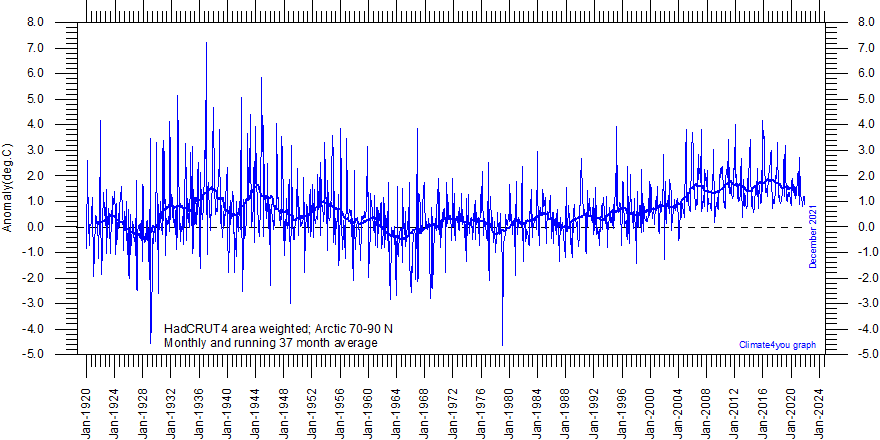
El Nino versus Arctic Temperatures

When the eco-idiots started going on about Arctic temperatures a few weeks ago, I thought one possible response was “we’d expect melting in an El Nino year”. However since El Nino is an equatorial phenomenon and Arctic melting isn’t … I was intrigued to find out whether there was a connection.
Well below is my highly scientific check:
ENSO-V-Arctic
Note Arctic temperatures from here and Enso from here. And for the sharp eyed amongst you, you will no doubt spot that I turned the El Nino/ENSO graph upside down because there are clearly some places where El Nino corresponds with cooler Arctic temperatures (like 1940) and La Nina with warmer (e.g. both sides of 1940). Also you’ll see a preponderance of La Ninas recently – and higher Arctic temperatures.
I think it’s reasonable to say that it is likely there is some kind of inverse relatinship but it is not strong and there’s also a low probablity that the apparent relationship is just chance (I tried dropping the graph down with various big offsets and with a bit of effort I could usually start to see possible correlations – this suggests apparent matches are relatively easy especially as I also allow inversion).
 

Posted in Climate | 1 Comment

The Ice-Age cometh

NotaLotOfPeopleKnowThat has an interesting graph which they post from NoTricksZone:

In a new paper (Stein et al., 2017), scientists find that Arctic sea ice retreat and advance is modulated by variations in solar activity.
In addition, the sea ice cover during the last century has only slightly retreated from the extent reached during coldest centuries of the Little Ice Age (1600s to 1800s AD), which had the highest sea ice cover of the last 10,000 years and flirted with excursions into year-round sea ice.
The Medieval Warm Period sea ice record (~900 to 1200 AD) had the lowest coverage since the Roman era ~2,000 years ago.

arctic-sea-ice-holocene-stein-17_thumbI know everyone is going to focus on the little blip (or not) at the end which either does or does not show Arctic ice is currently melting, but what I find interesting is that the amount of sea ice appears to have been increasing for the last 2000 years.
The irony of course, is why on earth would anyone want to continue the trend shown in the last 2000 years and head into an ice-age. Indeed, if it weren’t for the lies from eco-activists and if most people sat down rationally to think about it, we’d all be trying to work out a plan to stop us going into another ice age.
The same is also true with levels of CO2. During the ice-ages, CO2 levels fall to a dangerously low levels below which it is doubtful many plant species could survive. This means there is a plausible scenario that live on earth as we know it may cease during a future ice-age when (without human intervention) CO2 levels could plumet below the level at which most plants … and therefore most animals … could survive.
If I were even mildly tempted into religious beliefs … I could quite easily believe there was some god being who deliberately evolved humans to save the earth from an icy doom by releasing all that locked up CO2.

Posted in Climate | 2 Comments

UAH Animation

I’m posting this because it took some time to align all the various layers, because it may be interesting to see, not because it seems to show anything in particular.
UAHFeb17
A few of things of note:

  1. Source: http://www.nsstc.uah.edu/climate/
  2. Dec 2015 is missing (so composite of Nov/Jan used as placeholder)
  3. Whilst this sequence is dominated by a “super” El Nino year, it’s not at all clear to me (apart from the El Nino months) that I’m seeing a huge amount of red. The regional variability is still much greater than any supposed global trend – which means any global trend may be the result of a chance occurance of similar long-term regional variability.
  4. There’s a clear pattern of Equatorial heat. It starts around June15 and then grows west of the Americas until it spreads out all over the equator from Dec15 to Jun16
  5. The other thing is that it appears heat patterns move eastward around the latitude of the British Isles and westward at the equator (although a finer division of time would be necessary).
  6. The colder than average areas (in what is otherwise a warmer period due to El Nino) seem to dominate in the “eastward moving” zones at about 50/60 North and south. But there’s also a few hotter than average areas in these zones.
Posted in Climate | Comments Off on UAH Animation