The Haseler gap: imminent global plummeting temperatures (in next ~2000 years).

Fig 13.2

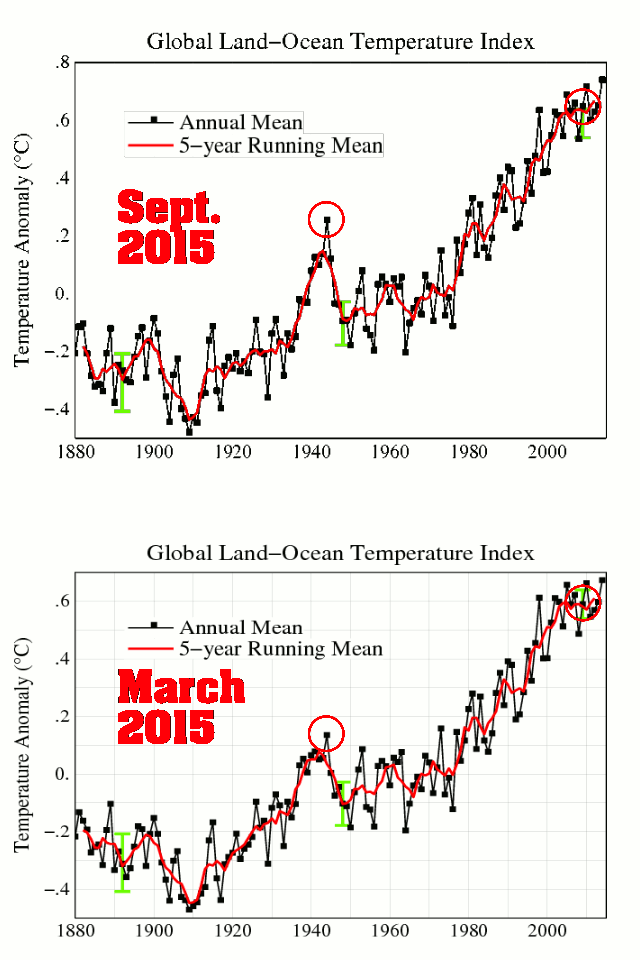
Fig 13.2 The “Haseler gap” – the period of rapid temperature drop 8-12k after the beginning of the interglacial without significant drop in CO2


A couple of months ago, when I looked at the ice-age cycle I came across something I referred to as the “Haseler gap”. This appears to be a recurring major drop in temperatures (~4C) a fixed period after the inter-glacial starts.
I knew I didn’t want to know how close we were to this gap in the present inter-glacial, because it would inevitably suggest that “this was the end” for human civilisation – and with almost nothing any of us can do (except find a super-powerful way to heat the atmosphere – which we’ve singularly failed to do!!!), we are stuck with what the climate throws at us.
It would not be a question of how many millions die, but how many billions. And there would be nothing we could do about it.
Unfortunately, today, I was stupid to measure the period. It’s only a rough measurement but at 8-12k after the beginning of the interglacial, we are now already due for this “Haseler gap”.
The Haseler Gap – is a lack of knowledge Continue reading

Posted in Climate | 8 Comments

Evidence against Leaky Atmosphere Hypothesis

The leaky atmosphere hypothesis is that the earth’s atmosphere leaks away over relatively fast timescales equivalent to the ice-age cycle and that this leads to changes in pressure causing changes in global temperature as suggested heer: (overviewcalculations),
Then I started checking this hypothesis. First I found:

This showed the Vostok ice cores had evidence of pressure change, but that instead of increasing when we can out of an ice-age it actually suggested a decrease. In retrospect, I think it is just a proxy for global temperature and that when it is warmer the ice is “more slushy”.
Then I checked extinction records and found a superb paper:

This appears to suggest that the animals that died out at the end of the last extinction had a lower metabolic rate. A lower metabolic rate would be an advantage if the air pressure was lower. But it is a relatively long and tenuous chain of inferences.
Then today I was answering a comment from Ian Macculloch on volcanism, when I suddenly realised that if there was “A” leaky atmosphere (i.e. unchanging), then the rate of leak should be a constant. And that therefore the rate should be a constant when the ice-age cycle was around 40,000 years long. And with a plot of 5million years of ice-ages I could easily check that! And by coincidence I had already highlighted the “decay” curve part of the ice-age cycle, so it was a very quick job just to overlay the 100k cycle over the 40k cycleRejectionOfLeakyAtmosphereAs can be seen above, the slope varies, but I cannot see many of the 40k (purple) slopes that are the same gradient as the 100l (blue).
If pressure were the sole cause of the ice-age cycle this shows that the rate of pressure loss would need to vary. At first I though “Great” … that theory’s busted I can now just ignore it! Unfortunately, on reflection, I realised that whilst a geological cause to the leak is busted (as these should be pretty constant), a biological cause cannot be so easily dismissed, as there could be slow evolution and/or spread of some biological species causing the leak rate to increase.
Moreover, the 100k cycle is significantly larger than the 40k cycle. It’s no where near 2.5x the size, but if e.g. half the warming were due to pressure (constant gradient), and half was due to something like a change of state (3-1 cell hadley) then the leaky hypothesis could produce the recorded ice-age plot.
Oh *&%$ what is happening?
Fundamentally something odd happened during the ice-age cycle.Five_Myr_Climate_Change_expand1Around 2.5million years ago, we seem to have entered an “oscillatory” phase of the climate leading first to a ~41k cycle length and then around 1million years ago that morphed into a longer cycle length of 100k.
This change in scale. On my monitor the 41k cycle starts when the amplitude is 1.5cm and the 100k when the amplitude is 3cm. That ratio is 1:2, whereas it should be 1:2.5. That isn’t a huge discrepancy (particularly when having to resort to measuring on monitors).
 

Posted in Climate | Comments Off on Evidence against Leaky Atmosphere Hypothesis

5 minute experiment shows IR heats water from above

Dr Roy Spencer has done an interesting experiment using two containers with water above which one has a silver foil which partly obscures the container from the cold sky.
This shows that water exposed to a higher radiant temperature is warmer. However, reading the comments I found some people arguing that this didn’t prove IR could heat water.
The controversy
For those who do not know, the controversy arises because IR is absorbed in the top few um of the water which evaporates off and/or because some people don’t believe in IR. This is all part of the argument that “back radiation” either doesn’t exist or cannot heat the sea. I usually keep away from the arguments, because back radiation exists. But this concept comes from greenhouse warming models which I describe as “noddy science”. They are just bad physics, not because of back radiation but for other reasons. So I have a lot of sympathy for those who don’t like these “backradiation” models of how greenhouse gases work and try to find fault with them.
Also, I don’t think the argument about heating water is completely daft – but I wish those who argue above water heating spent more time doing practical experiments and less time arguing the theory.
The Story
As I drank my whisky last night I thought “This is easy to prove”
I filled a tray ~1cm deep with cold water (at 18.6C using IR thermometer – which is possibly a few degrees higher than I expect, but perhaps it was sitting in a pipe). I put it under the grill which I then turned on as per this exhaustively researched experimental set up:

Pan of water under a grill

Pan of water under a grill


I set the timer to 5 minutes and then after five recorded the surface temperature without moving it – so when still irradiated. The IR thermometer read 63C. I then removed it – which inevitably stirred it, the IR thermometer read around 50C, I then gave it a good shiggle to ensure it was mixed up and it still read around 50C.
The 63C was at a low angle with IR still present and probably raised by reflected IR – but it might be interesting to repeat it with deeper water to see if there was noticeable surface warming. But the key measurement of bulk temperature had definitely increased by a good 30C.
For interest I measured the various surfaces inside the grill and they varied from 30 to 60C. The 30C was at the far end which had much less radiant heat, but was in much the same air temperatures. So, this is the worst case scenario of “air heating”. Air heating cannot explain the increase in the water.
The 60C was the surface closest to the tray – so it was being heated, but only to a very similar temperature as the water.This shows that IR was heating both the side surface and water in a similar way. And clearly there was no significant temperature gradient that could explain the rise in temperature of the tray from the surrounding surface.
I then touched the grill base and confirmed it was much cooler than the heated water (so no conductive transfer from the base – probably the reverse).
And whilst I did not measure it directly, the hotter air leaving the grill remained pretty cool and certainly not high enough to heat the water this quickly. (It would be like trying to make toast on a central heating radiator!)
Heating was not from visible!
Finally, to avoid some comments on visible heating, the grill was so dark I had to use a very long expose (~10seconds). The element was actually much darker than the picture suggests.
This tells me that the intensity of the visible was less than if I had left the tray exposed to the kitchen light.
Having worked with LED lights, I can be very confident the light level was much lower than a 20ma LED. This means the available visible heating was much less than 20mw  and probably less than 1mw. So the visible was around 1millionth that of the IR and if anyone even suggests the heating was visible red, …
Conclusion
IR certainly heats water from above: and if the effect is just at the surface, then thermal conductivity rapidly transfers that heat into the bulk of the water.
It might be worth trying this with deeper water. But I can probably calculate it quicker (see: Caterpillar III) than the ~20min experiment would take with deeper water ~5cm deep.

Posted in Climate | 11 Comments

How Greece subsidises Germany through the Euro

If you listen to the likes of the europhile BBC, you get the idea that the sun shines out the backside of the Euro, that Germany is doing Greece a favour lending it money and that Greece is just a bad boy that won’t accept the magic which comes as part of the Eutopian vision of the BBC.
But the real truth is that far from Greece getting subsided by Germany, Greece is actually subsidising Germany by being in the Euro. And the reason is simple:
If you have two companies, one with a higher cost of production and the other with a lower cost then the one with lower costs can always drop its prices to the point where it is making money and the other is not. So, the one with higher costs has no option but to try to sell its products at a higher price and be undercut by the more efficient company. This is in effect what we have with Greece and Germany in the same currency. German, which has invested heavily in manufacture & economic infrastructure, vastly outperforms Greece.
But if Greece and Germany had separate currencies, the Greek currency would devalue until the price of its goods were below that of Germany. Then Greece would be able to compete on equal terms, because the drop in currency value brings down the cost of employment in Greece, brings down the cost of raw material in Greece and generally makes Greek produce cheaper than Germany’s and Greece becomes a great place to do business.
In contrast, the rise in value of the Deutschmark then makes Germany a bad place to do business: it’s prices are higher, the cost of goods and raw material from Germany are higher and generally even German companies start buying abroad.
Greece wins in a separate currency – Germany wins in the Euro Continue reading

Posted in Climate | 3 Comments

How to survive a Scottish heat wave

I remember holidaying in Shetland and my son complaining about the heat. It was probably no more than 24C, but when you are used to houses heated only to 18C and its a day for stripping off and sun bathing if it ever reaches 20C, 24C is hot.
And as I said in a previous article, we’ve had one of the coldest Junes in 40 years in Scotland. Tomorrow we are told by the BBC-Met Office, that it will reach 27C. So, this is very much from the fridge into the oven with no acclimatisation.
So this is the plan:

  • Ice cubes have gone into the freezer
  • All the windows have been open full since early morning.
  • If the sun breaks through the curtains will be shut (but best to keep the draught)
  • When the outside temperature (currently 16C) goes above the internal temperature (currently 18C), I will shut the windows and shut any curtains I can.

This evening and tomorrow morning (not when we are sleeping) I plan to repeat the exercise, opening the windows wide if the inside temperature is above outside.
This should easily get us through one day of 27C.
But, if this were to continue for a few days (which it does not look like it will), I would continue this exercise until the nights start getting too warm to cool the house, and then in the past living further south, I found the best thing was just to shut any curtains on the sunny side and leave the upstairs windows open as much of the time as I could and doors on the shaded side of the house.

Avoid the chimney effect

But if you want to stay cool (and there’s no point in Scotland getting used to warm!) whatever you do, avoid opening windows and doors on sunny side of the house because of the chimney effect.
This is because the air on the sunny side of a house is in a sun trap between the warm ground and warm wall of the house and so is a lot warmer. If the windows/doors on this side of the house are opened with upstairs ones also open, the house can act like a giant chimney flue, sucking in warm air at ground level and super-heating the house well above the ambient which makes it impossible to sleep at night (particularly in the UK which is relatively humid so that humidity rises substantially at night).

An alternative gullibles strategy

If I were a gullibles activist with a highly paid job telling other people how to cut down carbon emissions, I would not only have the money but be stupid enough to use this strategy:

  1. Turn up the central heating (in Summer!) each day before the heat wave so that you get used to temperatures up to 27C.
  2. When the heat wave comes – enjoy it (probably in your outdoor heated swimming pool with those solar panel ornaments you keep meaning to get working – whilst you heat it with coal powered electricity).
  3. Then when it passes – just keep the central heating turned up – after all you are working in some massive green corps and your massive salary means you are doing a lot to save the planet, so you deserve to be allowed to emit more CO2 than everyone else.

Other Gullibles strategies:

  1. Drive around in your air conditioned 4×4 (which you convinced yourself you need to visit your wind investments).
  2. Buy a big air conditioning unit – and convince yourself that you are someone special that deserves to be cool whilst all the sceptics are boiling in their own heat because of all your good works.
  3. Get an air plane ticket to Greenland to watch those poor polar bears (which you said aren’t there) and see all the ice (that you say melted) and stay in a nice cosy hotel (heated to the same temperature you are escaping and one you claim would be catastrophic for humans).
Posted in Climate | 1 Comment

Greenhouse warming test cases – do you agree?

I came across a couple of articles by Dr Roy Spencer on how greenhouse gases work and was surprised at both his answers and also the multitude of comments. There appears to be many diverse views on the theory, but do these matter in practice? To test this I propose to go through the various extreme cases of atmosphere to see whether others agree with the temperatures I derive. If not I would ask them to explain why they get a different answer.

Roy Spencer’s articles

What first prompted me to write this article is one by Roy Spencer : Why Atmospheric Pressure Cannot Explain the Elevated Surface Temperature of the Earth in which he appears to suggest that adiabatic warming doesn’t affect surface temperature. This is clearly wrong, so I started writing a letter to him to check whether whether I understood him correctly when I found another later article by him: What Causes the Greenhouse Effect? in which he seems to have changed his mind and agree that adiabatic lapse rate does affect surface temperature but now suggested adiabatic lapse is only caused by “greenhouse gases”. This also appears to be wrong, because the lapse rate is mainly a result of the adiabatic law:

P1-γ Tγ = constant

And so long as γ ≠ 1 , temperature will vary with pressure as it expands upwards. However keen observers may be thinking this only applies to a system where no work done. But if air rises it loses potential energy. So, each atom has less energy because it takes energy to raise the mass of the air against gravity. But fortunately, it all seems to work because the work done as the air expands exactly matches the loss in potential energy (however I digress).
So, to check whether there was a real difference in interpreation, I wanted to do is pose a number of hypothetical extreme case atmospheres, and ask whether those like Dr Spencer agree with the values I derive.

Hypothetical atmosphere

I wanted to minimise the complexity of my hypothetical planet to the minimum so that IR emitted from the surface and atmosphere could be treated entirely separately from incoming solar.
My hypothetical atmosphere based on the following diagram with the one major difference that the adiabatic lapse rate is assumed to be linear with height. Also please note the real atmosphere is in contact with the ground – whereas I drew a gap here so that I could show the various heat flows between the planet surface & atmosphere).

Simplified atmospheric model: transparent to visible, opaque to IR

Simplified atmospheric model: transparent to visible, opaque to IR


Specification of the atmosphere (unless otherwise stated in example): Continue reading

Posted in Climate | 24 Comments

Evidence global air pressure changes (and causes mass extinctions)

I’ve been looking to find any evidence that might suggest global pressure has changed as suggested by the hypothesis that the end of the ice-age is caused by around a 30% increase in global air pressure (equivalent to an increase in altitude of 3200m) (overviewcalculations).
My first thought was that because birds rely on air to fly, that these would show the largest effect. In fact, I find that many birds can fly as high as Mount Everest, that they are actually better adapted to lower air pressures than mammals. (Which might explain why mountains have so many birds of prey). So far from birds having problems during the ice-age, this suggests that birds would have a physiological advantage over mammals in a lower pressure atmosphere. So we might expect more larger birds – even carnivorous birds.
Then I remember the giant carnivorous birds and wondered if their demise coincided with the end of the ice age. But, there’s no evidence for this as they died out much earlier**
**(but that doesn’t stop the BBC  who have a page suggesting they died out 15,000BC. This contradicts the evidence above and it likely is another symptom of their view that humans are evil. So I guess this is when the area formerly inhabited by this bird had its first humans).
Finally I started a general search for extinction events associated with ice-ages and came to this paper:

Determinants of loss of mammal species during, the Late Quaternary ‘megafauna’ extinctions” Johnson(2002)

This is an interesting paper, because if you were to read Wikipedia on the “quaternary extinction event”, you will find that the BBC view (i.e. quaternary extinction is another man-made event) is the PC norm. So this paper is clearly sceptical (aka scientific) in nature when it says:

The results of this analysis reject the hypothesis that these extinctions were caused by selective hunting of large-bodied species. Johnson(2002)

Risk of extinction is clearly related to reproductive rate
More importantly, it clearly links these end of ice-age mass extinction event to reproductive rate:

These analyses demonstrate correlations of both body mass and reproductive rate with extinction. However, of these two variables, only reproductive rate is needed to explain the pattern of extinction.

[T]he most striking feature revealed by this analysis is the consistency of the pattern of loss of species in the regions considered. In each case, the majority of species with reproductive rates below one offspring per female per year went extinct, unless they were arboreal or lived in closed habitats. The impact of reproductive rate on risk of extinction was quantitatively alike in different regions and for different groups of mammals, and the power of habitat and arboreality to alleviate that risk was similar. Johnson(2002)

This is so far the only paper with any general observations of how general physiology might relate to end of ice-age extinction so it is very important.
Metabolic rate & air pressure
Because air pressure directly affects the amount of oxygen available and therefore metabolic rate, I would expect those species that were best adapted to a low-pressure regime would be those with the lowest metabolic rate. In other words, in the same environment (so where species are competing head to head and numbers stable) there would be a competitive advantage for species with a higher metabolic rate if air pressure increases and therefore those with a lower metabolic rate would be more likely to become extinct.
This is important, because the end of the ice-age also saw an increase in temperature which in turn led to other changes to the environment and so it is difficult to find anything that specifically relates to pressure which is not also affected by temperature.
But generally if the only change were temperature, we would expect the same environmental niche to tend to move poleward to offset rising temperature as the world warmed. In this way the same environmental niche would have the same species and so they would continue to compete equally with each other albeit in areas further to the poles.
But, if pressure increased by the equivalent of 3200m, then we would expect the same species tending to generally move down hill by 3200m. However, whereas environments can over time move poleward (barring seas) , it is obviously not possible for an environment to move downhill if it is already below 3200m!
So, all animals should be able to cope with a general slow change in temperature with any particular group obviously being favoured. In contrast if pressure changes, then there is a distinct advantage for those with a higher metabolic rate as pressure increases, and those with a lower metabolic rate as pressure decreases.

Is Metabolic rate linked to Reproductive Rate

Johnson(2002) showed that the end of the ice-age extinction event is linked to species with low reproductive rate. But is reproductive rate linked to metabolic rate and therefore oxygen use so that it would be related to atmospheric pressure?
I found a fairly assertive answer to this question in “TOWARD A METABOLIC THEORY OF ECOLOGY” Brown et al 2004

Population dynamics can be complex and unpredictable, but the potential for exponential growth that underlies these fluctuations has been called the one unequivocal law of population ecology (Turchin 2001). The maximal rate of exponential increase, rmax, is predicted to scale according to Eq. 7. This follows from the fact that reproduction is fueled by metabolism,

[Equation 7 B ∝ M^(-0.25)e^(E/kT)]
Where B is population, M is body mass, E/kT is a value of metabolism.
]

Conclusion

This appears to show that it was those animals with the lowest metabolic rate or best adapted to low-oxygen levels which became extinct at the end of the last ice-age. As there is no evidence I know that the level of oxygen changed, this then is strong evidence that those animals that became extinct were those adapted to a low atmospheric pressures and hence that pressure significantly increased at the time of these extinctions.

Sense check

Continue reading

Posted in Climate | Comments Off on Evidence global air pressure changes (and causes mass extinctions)

Evidence global air pressure varies? – Is this a wheel falling off the caterpillar?

Thanks Josh cartoonsbyjosh.com

Thanks Josh cartoonsbyjosh.com


The main prediction from the caterpillar theory of plate tectonics is that we should see changes in volcanic emissions resulting in changes to the atmosphere such as increasing CO2 & pressure.
The Caterpillar theory is that thermal expansion during the ice-age leads to one plate of the crust being pushed under another. It then cools pulling out from the mid ocean ridges and so tends to move like some caterpillars.
There is strong evidence that the ice-age cycles affect mid oceanic ridge formation and the rise of CO2 as the crust warms is also supportive evidence for this theory (although hardly conclusive as we also expect outgassing).
In my last couple of posts (overviewcalculations), I speculated that global pressure had been changing significantly in recent geological times and that possibly if the air pressure increased by 30% that would be enough on its own to cause the 8C warming we see coming out of an ice age.

How can we prove a change in pressure?

I thought about looking for a correlation with some physiological aspect of bird – because surely they need “thick” air more than any other creature? All I found was that birds fly well above Everest and that there does not appear to be much of a limit in terms of air pressure. That in itself may be evidence that the earth’s pressure has been lower and we now have birds adapted for much lower air pressure – but that is just speculation.
I thought about possible geological signatures from the change in boiling point of water from 100C to around 90C. But there are few places where we see natural boiling water exposed to the air today – so there’s a very slim chance useful changes have been recorded.
Another possibility is that dissolved gas content will change in water. I’ve looked for research into high altitude water to see whether there are any changes which might be recorded in some way – but so far I’ve not found anything.

The evidence I need ??

Continue reading

Posted in Climate | 3 Comments

More wheels falling off: UK plans to get rid of "gullibles" investment bank

I can’t turn around these days without finding more bad news for the alarmists. This time, the UK government are ditching the so called “Green investment bank” which was another way to pump public money into the pockets of carbon sharks.
This sums it up:

critics have called plans for a sale “reckless”, and said that the move calls into question the government’s commitment to a low carbon economy. (link)

This is all part of the same common sense dismantling of the CO2 scam. Hopefully some gullible-green idiots like the Guardian will put all their money into the bank. That way when it goes belly up they will lose the lot, they will no longer have the massive AUTOMOBILE funded nest egg that allows them live in a cloud cuckoo land. Instead they will have to start writing what the public want to read rather than what they want the public to believe.

Posted in Climate | 2 Comments

Calculation of pressure change need to induce ice-age cycle

In my previous post I suggested that the addition of gases to the atmosphere from volcanic activity could have increased the atmospheric pressure and that would have changed  global temperature giving us the current warm interglacial.
Today I thought it was worth putting some figures on that (thanks to Will Janoschka for the question that prompted it). And here it is: PressureGlobTempI don’t claim to be doing anything other than using the approximation given by Niklov and Zeller 

Ts/Tgb = exp(.233Ps^0.0651 + 0.00154Ps^.385)

Where Ts is surface temperature (C), Tgb is earth’s “grey body temperature” which I treat just as a constant as given in the paper (154.3C), and Ps is surface pressure of around 100,000 pascals.

This suggests that in the ice ages, the 8C lower temperature could be explained by a 30% drop in pressure. That is equivalent today of an altitude rise of 3200m. For us living in Scotland where our highest mountain (Ben Nevis) is around 1300m that sounds high. Continue reading

Posted in Caterpillar, Climate | 5 Comments