Gill 1: Changing Climates

Collection of five Surrey Mirror Group Website Articles written by Peter F Gill and posted from about March 2015 to January 2016. They now no longer exist on the Internet unless archived by someone.

Climate change is what Earth’s climate does and for a large variety of reasons. Many causal factors have origins external to Earth. These include: the gravitational induced changes to the Earth’s orbit around the Sun (probably largely the influence of Saturn and Jupiter); the changing cosmic conditions as our local solar system orbits our own galaxy; the changes in solar emission of electromagnetic radiation and particles (mainly alpha and beta particles which are Helium nuclei and fast electrons respectively): the changes in the magnetic fields of the Sun and Earth and their coupling : the gravitational effects of the Moon.

Internally because of our rotation and the complex chaotic interplay between our atmosphere and our oceans further variability in climate is inevitable. This would be true in a lifeless environment. However, living things have had a major effect on the composition of our atmosphere notably the increase in oxygen content. Mankind is not an exception but are we the dominant cause of climate change which is the current claim by many. Local climates have clearly been modified by mankind for thousands of years mainly through changes in land use, particularly de-forestation. Since the 1970s mankind’s effect on the climate has increasingly been focused on the consequences of burning fossil fuels and in particular our emissions of carbon dioxide which is a so-called greenhouse gas. The subject probably first came to the public’s attention through warnings of global warming or Anthropogenic (mankind induced) Global Warming (AGW) or the rather direr scenarios of catastrophic AGW (CAGW).

In my first article, published in the paper on February 19th, I explained that quite a number of individual hypotheses comprised the overall AGW notion. By its very nature an hypothesis is a reasonable speculation of a correct explanation of one or more facts. In science it is not a truth or a belief just a working idea and maybe the first step towards a theory and onto a law of science.

I listed six of the main hypotheses that form the overall AGW hypotheses as follows:

  1. the increase in carbon dioxide (CO2) over the last 200 years has been caused by the burning of fossil fuels,
  2. effectively all anthropogenic CO2 emissions since the beginning of the industrial revolution remain in the atmosphere,
  3. as a greenhouse gas CO2 absorbs upwelling infra-red radiation from the Earth and re-emits in all direction effectively causing warming,
  4. the increase in heat evaporates more of the primary greenhouse gas, water vapour thus multiplying the effect of CO2 increase by a factor of about 3,
  5. further atmospheric heating will release methane from permafrost – a tipping point at which it is postulated run-away global warming will occur,
  6. the amount of carbon dioxide in the atmosphere is and always has been the main climate driver.

The idea for subsequent columns was to examine and challenge each of the AGW ideas with new facts and alternative hypotheses and to deal with any questions arising.

The second column published on 12th March questioned whether the increase in CO2 over the last 200 years has been caused by burning of fossil fuels. Further articles will appear only on the web site and will deal with the other five hypotheses listed above.

AGW Hypothesis (i) the increase in carbon dioxide (CO2) over the last 200 years has been caused by the burning of fossil fuels

Carbon dioxide (CO2) is a trace gas in our atmosphere weighing about 3,000 Giga tonnes. This may seem a lot but, put another way, over 99.95% of our atmosphere is not CO2. There is about 50 to 60 times more CO2 in the seas than in the atmosphere. The gas is responsible for life on Earth. You breath in about 400 parts per million (ppm) with every breath. You then breath out about 40,000 ppm of CO2! That’s about a third of a tonne per year of CO2 each.

There is a continuous interchange between CO2 in the atmosphere, in the seas and soils caused by many factors, particularly life itself. In any one year, completely natural emissions, mostly from equatorial areas, can be 600 Giga tonnes with considerable variability from year to year. Our current contribution from all our activities is circa 30 Giga tonnes. Of course, the seas, soils and the ecosystem absorb a similar quantity to yearly emissions but there is never a perfect balance and so atmospheric levels follow trends created by many factors.

Over the past 200 years, atmospheric CO2 has been increasing. This period coincides with industrialisation and the increased burning of fossil fuels. There is evidence that the nature of atmospheric CO2 is changing because fossil fuels are richer in a lighter form of carbon (for more detail research the isotopes C12, C13 and C14). It would therefore appear reasonable to assume that we are to blame for the increased CO2 levels.

However, the same period is characterised by us coming out of a Little Ice Age when there were ice fairs on the Thames. Natural variability caused the two most recent warm periods – the Roman Warm Period and the Mediaeval Warm Period and so why not the present warm period? Well this is where things get contentious and it’s partly to do with the solubility of CO2 in water and the chemical reactions that take place particularly in sea water.

Carbon dioxide is very soluble in cold water. As temperature increases solubility decreases. Solubility depends on the pressure of the CO2 over the water. So let’s assume that sea out-gassing is the reason for the increase in CO2 in a warming world. If we burn fossil fuels, the CO2 released contributes to the pressure of CO2 and consequently prevents what would otherwise have come out of the sea. The overall result could be similar to the natural emissions. If you would like to look into this matter in more detail Google Henry’s Law.

AGW Hypothesis (ii) effectively all anthropogenic CO2 emissions since the beginning of the industrial revolution remain in the atmosphere

This hypothesis is a more extreme version of the hypothesis that all the increase of atmospheric CO2 is anthropogenic in origin. It uses two assumptions. Firstly, that pre-industrial levels of CO2 were more or less constant around 280ppm and that this level represents a “correct” amount of CO2 in the atmosphere. It is argued that the increase in the quantity of the light form of carbon (isotope C12) relative to the heavier carbon (C13) demonstrates that the increase in the gas is a consequence of fossil fuel burning. This is not a wholly credible hypothesis for a number of reasons. The assumption of constancy of past CO2 levels comes from ice core data. This has some known problems. Secondly, the amounts of CO2 emitted and contained in the atmosphere do not tie up. Thirdly, thirty plus experiments, using different methods, have shown that the range of residence times, that an individual molecule of CO2 remains in the atmosphere, is from 4 to 25 years with 5-6 years being typical. There is a further argument about residence times suggesting that it will take many hundreds of years for atmospheric CO2 to return to pre-industrial levels. Perhaps I will return to this notion at a later date. Most likely it can be covered when discussing the reason that the International Panel on Climate Change has set-up and its consequent approach.

Posted in Climate, FGill | Comments Off on Gill 1: Changing Climates

Russians funding the Greens

DYPS2sHX4AA8_Dy.jpg largeFor years, it’s been obvious to me that the people who stand most to gain from the global warming scam are:

  1. Those in the UK with their snouts in the trough
  2. Oil & Energy companies who get a massive boost to profits whenever energy prices go up
  3. Foreign governments like China and Russia who want to undermine the west, and particularly those like Russia who sell us oil, and want us to become massively indebted to foreign energy suppliers.

And I note the following:

  1. Whilst the BBC excluded all sceptics, there was a Chinese citizen on the board of 28 determining BBC policy on global warming.
  2. The Russians were caught red handed funding greengroups
  3. There is persuasive evidence of Saudi funding of anti-fracking groups.
  4. Oil companies were a major backer of the global warming campaign.
  5. And there’s an awful lot of people who do this …

Troughers

Posted in Climate | 1 Comment

An N-dimensional space representation of the problem of initial values with ensemble forecasting

We are all familiar with the concepts of 2 dimensional graphs with an x and y axis. It is not too difficult to understand how we might add a third and have a z axis. On such graphs a point represents a combination of 2 or 3 parameters (x,y) or (x,y,z). For orthogonal variables of equal scale we can use an analogy of distance between points in that the distance is √(x2 + y2 + z2). As such we can refer to any set of parameters where this relationship is expected to exist using the concept of “space”. This concept can be extended beyond three dimensions to 4, 5 or even much higher.
A digital model of the atmosphere consists of a large array cells. Each cell contains a set of parameters. If these are linear and can be scaled, then they can be represented by a distance. For n cells, each with m parameters, these can be represented by n.m dimensional space, and the set of parameters characterising the atmosphere can be plotted as a point in n.m space.
When an ensemble forecast is run using a ray of initial values, these initial values correspond to a set of points in the n.m space and in order to explore this space they are chosen to be widely dispersed.

The butterfly effect

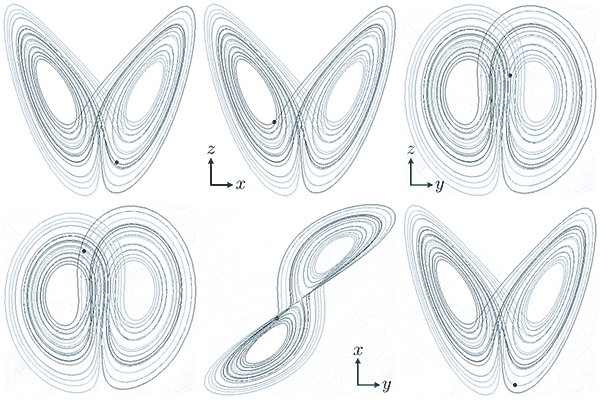
A_Trajectory_Through_Phase_Space_in_a_Lorenz_AttractorThe butterfly effect is a phenomenon whereby small perturbations in the atmosphere tend to grow to become larger and larger. This means that if we go back far enough, these perturbations will be so small that they are smaller than the highest precision that can be reasonably used in a model. These perturbations are represented in n.m space by points, but just as phenomenon like the flap of a butterfly’s wings can grow in the atmosphere, so within n.m space, starting conditions that are so close together that they cannot be distinguished tend to grow to expand more and more space.
However, because n.m.space is constrained by what is physically possible, if some parts of the space being to expand, then other parts must shrink.
PrintThe effect is that whilst the initial set of conditions of a ensemble forecast may be reasonable well spaced in n.m space, as small areas of the space expand due to the butterfly effect, the space occupied by the initial perturbations destroys and no longer becomes evenly spread. The result, is that fairly quickly the initial perturbations are no longer exploring a well spread area of n.m.space but are instead bunched and at the extreme they become denser and denser areas leaving large unexplored areas of potential futures.
Thus in order to explore new spaces that open up, it is necessary to have a mechanism to redistribute the model points in n.m space.
One mechanism, is to add small perturbations – in the manner that a molecule in a heated gas is constantly knocked out – so that the ensemble forecast points tend to redistrubute themselves more evenly in n.m space.

Posted in Climate | Comments Off on An N-dimensional space representation of the problem of initial values with ensemble forecasting

Simple 1/f noise generator

It’s often useful to be able to play around with things to get a feel for how they work. One of these is 1/f noise. There’s a very simple algorithm for generating this type of noise.
We set up n storage locations. To start a random value (-1 to 1) is stored in each location, Then every 2nd step, the first one changes to a new random value (-1 to +1), every 4th step the second changes, every 8th step the third, every 16th the fourth, etc. until the last one change in the middle of the run.
If we then set it so that at each step only one storage location is changing, then if we sum all the locations we have a random value that changes only by a random value between (-1 to +1) at each step.
For the equivalent of 10 years of daily readings we need ~4000 steps and when graphed for a scale of years we should have something like this:
1-fgeneratorI’ve included a openoffice calc file and xls

Posted in Climate | 3 Comments

It's snowing again – again!

A while back I wrote an article saying it was the snowiest winter we had had. We then got the so called “beast from the east”. That brought Scotland to a standstill. For a few days it looked like it might melt away.
It’s now snowing and settling again.
I will be spending some serious money preparing for next winter.

Posted in Climate | 4 Comments

Small but significant risk of major loss of life in Scotland

Before the snow deluge, this winter had been worse than any in the 20 years we’ve lived in this location. It arrived earlier it remained cold and we had frequent period of snow that lay for a few days. But we had had deeper snow one year. That’s now changed and we’ve still got at least 3 more days of colder weather.

That is not the problem, like most people we stocked up on food and toilet rolls before the roads shut. And having bought snow chains (everyone laughed as we live in a suburb of Glasgow), it would take just five minutes to get to roads that are “drivable”.

The problem is that there is no way on earth the global warming obsessed Scottish government or local government could ever conceive of the amount of snow we’ve already had. They weren’t prepared for the last few winters when people were stuck up to 8 hours of motorways, they aren’t prepared for this. We have certainly got a few more days of this snow, but whilst there’s a couple of days has a maximum of 4C, that may be no where near enough to melt the snow. If people cannot restock their larders, cannot do minor repairs, and then there is even more snow as forecast … Continue reading

Posted in Climate | 3 Comments

BBC Newsnight hit by PIW (Politically Incorrect Water)

For years the BBC have carried what seemed to be an endless propaganda campaign on global warming. I gave up complaining when they falsely called us “deniers” but I can never forgive them for likening those of us who are rightly sceptical of “data” coming from the eco-zealots running NASA to paedophiles. Even for the Biased Broadcasting Company that has become a beacon of bigotry on subjects as wide ranging as Global warming to Scottish Independence (which I disagree with) and Brexit (which I agree with), that was a new low.
So, you can imagine I have been delighted to read the tweets from a well known Scottish BBC presenter Kirsty Wark who is now stuck on a train going no where.
DXHQ8a2WAAEksiA

DXHBgY2WAAcxkIw

Is that snow I see? No it can’t be snow! According to the BBC, that snow disappeared years ago and anyone denying that is a global warming denier.

No that’s not snow – it’s merely politically incorrect water.

Posted in Climate | 9 Comments

It's snow (again)

I’ve already declared this our snowiest winter in the last 20 years living here. The road is covered again. Whilst we don’t get as much snow as some would think (due to prevailing wind off the warm seas), we do usually get one or two snow falls that settle. We once had several weeks of frost – but that was one large snowfall which turned to ice.
This year however, the winter started early and we’ve had repeated snow showers.

Posted in Climate | Comments Off on It's snow (again)

The Anti-Greenhouse Effect (yes it is called that LOL)

This is a little gem I’ve got to share. Apparently not only have academics been daft enough to call the original effect the “Greenhouse effect” – when greenhouses work in completely different ways, but they’ve gone as far as to name something the “anti-greenhouse effect” – thus proving that the name “Greenhouse effect” is a total load of codswallop Continue reading

Posted in Climate | 5 Comments

Analysis of a joke

It is often said that any joke that has to be explained is ruined. However in this case, that might be the joke. So, to add to the excruciating nature of the joke here is my explanation.
There is another joke that goes:

“There are 10 types of people in the world, those that understand binary and those who don’t”.

That of course is what is being referred to by the “two types of people”. However, note that to accurately reflect the original joke it would need to be 10 types of people. That is why this is such a classic. Because you could use the “10” types of people for any base and have three groups:

“there are those who understand binary, those who don’t, and those who know there are more bases than binary and decimal”.

And of course, the number of possible groups can be extended even further … indeed up to an infinite base.
However a base 1 joke  is unique. Because there is only one number in a base one number system and that number is obviously zero.
So, clearly, we could have the joke of the form:

“There are 10 groups of people in the world: those who don’t understand base 1”.

That then fits the general patten of 10 jokes. Thus the humour in this joke is that “two” spelt out as a word does not work. It is clearly wrong – the teller was so bad at jokes they couldn’t even tell it properly. But then again, the pun on “10” only works when written not when spoken. And “those that don’t understand my humour” is only one group. So, the statement is clearly right, because how can anyone understand a joke that is palpably based on false logic and utterly wrong.
And that is the joke …
Which then, when you get it, makes the statement that there is only one group of people false … and it stops being funny.

No, No, No!
Sorry … just kidding!

The real joke is that’s its a a pun on function and dinner part and that the idea that anyone who thought the joke was funny would be invited to a dinner party in the first place.

Posted in Climate | 1 Comment