Corrupt Scottish press – no mention of Pachauri's planned visit to Scotland despite meeting with Scottish minister

McLeod

Dr Aileen McLeod, Scottish Minister for Environment & Climate Change

IPCC

Rajendra K. Pachauri, UN Chief climate scientist and alleged serial sexual harasser.

Why is Aileen McLeod, Minister for Environment & Climate Change hiding her arranged meeting with disgraced UN Chief climate scientist? Why are the Scottish press withholding details of this affair from the Scottish public? Continue reading

Posted in Climate, Energy, Scotland | 1 Comment

How to win the climate wars

I was reading Robert Bradley’s excellent blog Master Resource in which he discusses Ad hominen attacks. But I had to disagree with his assertion that the Ad Hominen attacks must cease. Indeed quite the reverse. Instead it is now my firm belief that the reason we sceptics have so far failed to make our case is because we have failed to undermine the people – NOT EVIDENCE, BUT PEOPLE – behind this scam.
Replying to Robert’s article I wrote:

If you hadn’t noticed, despite the complete lack of any trends backing them up, the failure of their models and the wholesale corruption of the alarmist academics and NGOs … sceptics have failed to win the climate wars by constant regurgitation of the same data and graphs which overwhelmingly proves us right, but apparently goes down like a lead balloon with most journalists, politicians and environmentalists.

For these science illiterates, the whole argument is this: “someone they deem to be an authority in society because they are referred to as a ‘scientist’ says … doomsday warming is happening.”

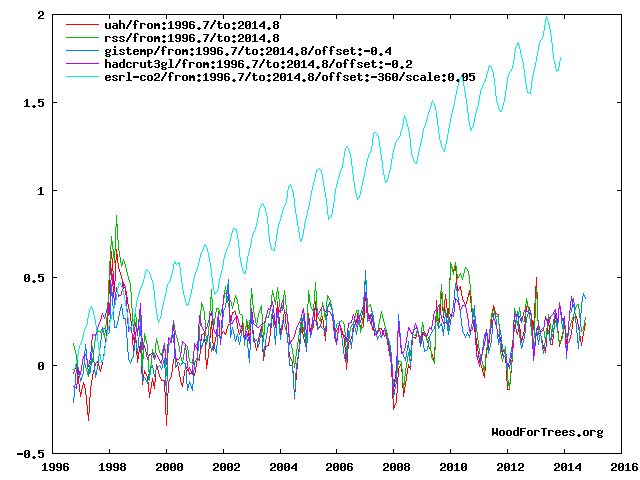
No end of graphs showing that it hasn’t warmed for 18 years or showing that similar warming and cooling periods are prevalent throughout CET will convince these scientific illiterates.

Instead we have to stop them believing that some academic with no more claim to speak on climate than you or I, should be accepted as an “authority”.

Because for the vast bulk of the population who do not have the education of sceptics, there is little choice but to judge the issue of doomsday warming based on whether those PEOPLE they perceive to be “authorities” say it is true or not.
We will win this war. Continue reading

Posted in Climate | 4 Comments

It's easy to convince an alarmist – ad hominen attacks!

Following the results of the survey I concluded that it was easy to convince a sceptic – just show them the data. But the data and analysis does not lie. And the inevitable conclusion from my detailed analysis is that climate alarmism stems from the combination these factors:

  • Ignorance & inability to analyse the data
  • Susceptibility to social pressure
  • Reliance on views of authority

So, we sceptics may as well be talking Klingon to most alarmists when we present another detailed analysis of the data packed full of graphs, particularly when these don’t mention any supposed “authority”, even if that authority is a geneticist or a would-be monarch both of whom are clueless.

How to convince an alarmist

The conclusion of my research is very clear. If you want to convince an alarmist you have to do it socially and not present detailed data analysis which most don’t understand. Continue reading

Posted in Climate | 2 Comments

Distribution of Grain size with depth in dikes

The caterpillar theory of plate tectonic movement predicts that just as we see cracks developing in soil that has dried up, so we expect to see much larger, deeper & repeated cracks developing from the surface downward, one new set for each ice-age perhaps as much as 1-2km deep.
The following video shows that (some) sedimentary dikes were not created in a single event, but instead consist of repeated events whereby the cracks expand and then are in-filled essentially with surrounding material. This suggests that there is some kind of cyclic event, each additional layer represents a new cycle.
This appears to be very good proof supporting the caterpillar theory of plate tectonic movement which suggests a significant part of plate tectonic movement is caused by thermal heating and cooling over longer term ice-age cycles. Just as we see cracks developing in soil that has dried up, so when the crust cools over the 100,000 year ice-age period, the crust will shrink from the surface and so we expect to see much larger and deeper cracks than those from dry soils developing from the surface downward, perhaps as much as 1-2km.
Therefore it seems likely that each of the following layers represent one ice-age period.

Posted in Caterpillar, Ice age | Comments Off on Distribution of Grain size with depth in dikes

The truth behind the environmental movement

The truth about environmental protesters:

  1. They are almost clueless not only about the issue they are protesting about but on the simplest science.
  2. They have no real interest in the issue but just move from one to another.
  3. These events are coordinated by the shadowy figures – as clearly everyone has been told to say the same thing in advance.
  4. Most are just gullible people being manipulated by highly organised and well funded groups.
  5. For some reason they only start protesting when foreign government’s interests are being threatened.
  6. Organisers don’t get involved themselves, instead they hide behind the well-meaning and/or stupid people who attend these events.
  7. Most of the media are the same gullible idiots who just go along with these “for hire” eco-sharks.
  8. We’ll never see real investigative reporting like this in Scotland. (Unless it’s paid for by those who fund these organisations).

Posted in Climate, Energy, Environment, Fails, greenblob, Media, Politics | 2 Comments

Predictors of climate alarmism and scepticism

A year ago when the results of the survey were coming in, I started preparing to write a paper by doing a literature search to see what comparable research had been done. It was not a pleasant experience. The academic literature on sceptics (almost none of alarmists) was some of the most hate filled, dishonest garbage it has ever been my misfortune to read.
For example, in one paper alone I counted around 100 intentional insults about sceptics. That in a peer reviewed paper. It was what might best be described as “climate porn” not academic literature. However, just because a lot of the views are not credible, that did not mean that those papers did not have some information material to this survey and its analysis.
I forced myself to read these studies and as such I was able to tease out a few facts that do help draw some wider conclusions from the survey data which I would now like to present in a summarised form:
Terminology
The term “sceptic” is a very apt name for those sceptical of the claim of catastrophic global warming. However, from previous efforts to find an acceptable term for those on “the other side” I know there is extreme resistance to any group name. I suspect this in itself says something important about this group but I do not know what. But any categorisation however well intentioned appears to cause offence. So, as offence will be taken whatever term I use, I will use that which I believe to be most accurate which is “alarmist”. This refers to those participants on line who are alarmed by the prospect of catastrophic warming. And in this article I am not suggesting that alarm is unwarranted.
However, please note, whilst some academics such as Michael Mann make colourful contributions online, due to the anonymity of contributions no inference can be drawn from this work regarding other climate academics.
1. Suggestibility is linked to alarmism.

Perhaps the one  significant finding from the survey is that sceptics are very confident data analysts:  by education, by training and by experience.
In contrast, research by of all people, Lewandowsky (who is notorious for his attacks on sceptics) shows that alarmists were suggestible. Continue reading

Posted in Climate, My Best Articles, Survey | 8 Comments

What should define the start of the next ice-age?

I’ve often wondered what will be taken as the “start” of the next ice-age. Assuming the start is fairly gradual, we’d expect to see something that either has never happened before starting to happen or something that happens quite often becoming regular.
My own preferred measure would be something very simple, such as the first year in which ice remains continuously on the Scottish mountains.
However looking today I see that WUWT have an article: “4 of the 5 Great Lakes about to freeze over” and I thought that perhaps the first year of a succession when 5 of the 5 might be more likely.
Any thoughts?

Posted in Climate, Sceptics, Survey | 5 Comments

Joannne Nova: strips the climate scam bare.

Posted in Climate | 3 Comments

The Caterpillar Theory and it's use in predicting earthquakes

After the boxing day & Japanese earthquake and Tsunamis are geologists ignoring a vital tool that could be used to help predict earthquakes?
In the last article I provided a quick summary of the Caterpillar theory of plate tectonic movement. Put very simply, this is that warming & cooling over 1000s of years causes the crust to expand and contract. Expansion pushes the crust down at subduction Zones and contraction cause it to shrink causing fissures to form in the mid oceans which are then filled with magma which solidifies.
The result is that when the earth is subject to regular cooling and warming as we have over the 100,000 ice age cycle, this will cause the earth’s crust to move rather in the form of some caterpillars.

However, so far I have just treated the crust as a single entity. In reality, the above “arching” of the back of the caterpillar is very realistic. Because far from the entire crust expanding and contracting, the reality is that the expansion and contraction is greatest near the surface.

Ice-age temperature change1

Change in crust temperature. Note, this is the change in temperature on top of the ADDITIONAL temperature gradient as we get deeper into the crust.


But there is another curiosity. For simplicity, I’m going to refer here only to the change in temperature due to thermal change at the surface without the general increase we get with depth. So, when I say “cooler”, that is cooler with respect to a nominal very long-term temperature we expect at that depth.
Notice for example, if we pick the yellow line starting at +2C. Here the surface shows less warming due to this cycle than a few hundred meters down. So whereas the surface is beginning to cool, down at 1000m, the crust is still expanding. If we then look at the next green curve. We see that crustal cooling has reached down to around 1.2km. So above 1.2km, the crust is now cooling, but below 1.2km the drop in temperature that occurred has still not penetrated to that depth and it is still responding to the previous cooling of the globe from almost 100,000 years before.
However, if we go even further down into the rock, whilst the amplitude diminishes, we find that whilst the surface is cooling, then lower the rock is warming, if we go further down we find that again the rock is cooling and below that it is warming. So, in effect the temperature of the surface is going down through the crust in waves.

The Caterpillar Theory and Earthquakes

Therefore, one prediction of the caterpillar theory of plate movement is that earthquake zones should be depth related and that the depth of earthquakes should gradually move down into the crust over thousands of years.

Differential thermal expansion

Below is the graphic showing how expansion of the crust leads to earthquakes. What it does not show, is that almost invariably, the rock on either side of the subduction zone will be of different types and therefore expand at different rates.
plate-subductionNor does it show how the waves of expansion and cooling will move down into the crust. So, in a real situation with different rock on either side, the situation swill be more like the following:

Subduction zone showing waves of ice-age cycles going down into the ground with rocks with different thermal conductivity on each side. (Note in reality the isotherms will be curved near the fault line, but for simplicity this has not been shown).

Subduction zone (extended vertical scale) showing waves of ice-age cycles going down into the ground with rocks with different thermal conductivity on each side. (Note in reality the isotherms will be curved near the fault line, but for simplicity this has not been shown).


Now, instead of the rock expanding or contracting uniformly across the fault line with a gradual change with depth. Now, there are a series of pulses of hot and cold going into the ground and along the fault line one side may be cooling whilst the other is warming. Now these zones of stress will move slowly into the ground making it very likely that they will at some point trigger an earthquake.

Posted in Caterpillar, Ice age | 2 Comments

Toward a new theory of ice-ages XV (implications)

In this article I want to explore what this new theory implies about the present political debate called “global warming”. Continue reading

Posted in Caterpillar, Ice age | 2 Comments